
Fence Contractor in Colchester, CT Cedar, Vinyl, Aluminum, Rail and Chain Link
A family-run Connecticut fence company, building since 1979 and based in neighboring East Hampton. We measure your Colchester property, tell you honestly what will work, and build it with our own crew.
In this guide
- A Fence Contractor Colchester CT Homeowners Can Reach Directly
- Colchester Ground: Glacial Till, Ledge and Frost
- Which Fence Fits Which Colchester Lot
- Fence Types We Install in Colchester
- Rail and Pasture Fencing for Colchester Parcels
- What Affects the Price of a Colchester Fence
- How an Arrow Estimate Works in Colchester
- Colchester Permits, Zoning and Wetlands: What to Check
- When a Fence Is Not the Right Choice in Colchester
- Towns Near Colchester We Serve
- Frequently Asked Questions: Fence Contractor in Colchester, CT
- Ready to Talk About Your Colchester Fence?
Quick answer: who installs fences in Colchester, CT?
Arrow Fence Inc., a family-owned Connecticut home improvement contractor (HIC.0537503) based at 192 East High Street in East Hampton, installs cedar, vinyl, aluminum, post-and-rail and chain link fences in Colchester. We give free on-site estimates, quote in writing after measuring, and build with our own crews.
Colchester is mostly stony glacial soil, with ledge and wetlands on many lots, so the right fence depends on your parcel. Call (860) 267-6636 or request an estimate and we will walk the line with you.
A Fence Contractor Colchester CT Homeowners Can Reach Directly
Colchester sits in New London County, where Routes 2, 16 and 85 come together, and it is one of the closest towns to our East Hampton office. That matters more than it sounds. When the company that measures your yard is a short drive away, a question about a gate swing or a property pin gets answered by phone or a quick return visit instead of a ticket in someone else’s queue.
Arrow Fence Inc. has built fences across central and eastern Connecticut since 1979. Stephen Howard founded the company and his wife, Maura Howard, is its president. We install cedar privacy, cedar picket, vinyl, aluminum, post-and-rail and chain link, along with commercial fencing, for homeowners, farms, schools, churches and businesses. You can see our fence gallery for finished work and read more about the company.
This page is written for Colchester specifically: what the ground tends to be like, which fence suits which kind of lot, what to check with the town, and where a fence is not the right answer. If you only want a number, call us. If you want to understand the decision first, keep reading.
Colchester Ground: Glacial Till, Ledge and Frost
Much of eastern Connecticut sits on glacial till, a dense mix of clay, sand, gravel and stones left behind when the ice retreated. Colchester is no exception. In practice that means post holes are rarely clean. A crew may drill through a foot of soil and hit a boulder, or find ledge a couple of feet down on one side of a lot and deep, easy soil on the other. We cannot tell you which you have from a satellite photo, which is one reason we walk the fence line before quoting.
Frost depth and post depth
Connecticut winters heave shallow posts. Our post depth and frost heave guide explains why posts are set below the frost line, which is roughly three feet in Connecticut, and what happens to gates and panels when they are not. A fence that looks fine in October can rack out of alignment by March if the footings were too shallow or sat in poorly drained ground.
Wet spots and drainage
Colchester has brooks, ponds and low, seasonally wet ground in many neighborhoods. Posts set in soil that stays saturated shift more and wood rots faster at the base. In those spots we often steer people toward vinyl or aluminum, which do not rot, or toward a design that keeps wood boards off the ground. If part of your lot is genuinely wetland, that raises a regulatory question as well, which we cover in the permit section below.
Slope
Rolling lots are common here. Panels on a slope are either stepped, like a staircase, or racked to follow the grade. Both cost more labor than a flat run, and some styles (a solid six-foot panel in particular) look better stepped than racked. We will tell you which approach we would use on your slope before you commit.
Which Fence Fits Which Colchester Lot
Colchester is a mix of village-center streets, newer subdivisions, wooded back roads and larger rural parcels. The same fence rarely works for all of them. This table is a starting point, not a rule.
| Property | What people usually want | Fence we would look at first |
|---|---|---|
| Village-center and older homes | A defined yard with traditional curb appeal | Cedar picket, or aluminum with a classic look |
| Newer subdivision lots | Backyard privacy with little upkeep | White or tan vinyl privacy, or cedar privacy |
| Wooded back-road lots | Dog containment without losing the view | Aluminum with puppy pickets, or rail with wire mesh |
| Horse and hobby-farm parcels | Visible, safe pasture boundary | Post-and-rail with mesh, in cedar or locust |
| Pools | A code-aware barrier with a latching gate | Aluminum, with the town’s rules confirmed first |
| Businesses, schools and utilities | Security, boundary or equipment screening | Chain link, aluminum or a mix on one site |
If your property does not fit a row, that is normal. Many Colchester lots combine two or three of these situations, such as a pool behind a wooded line, and we often use two materials on one job: aluminum where you want open sightlines, cedar where you want a screen.
Fence Types We Install in Colchester
Cedar privacy and cedar picket
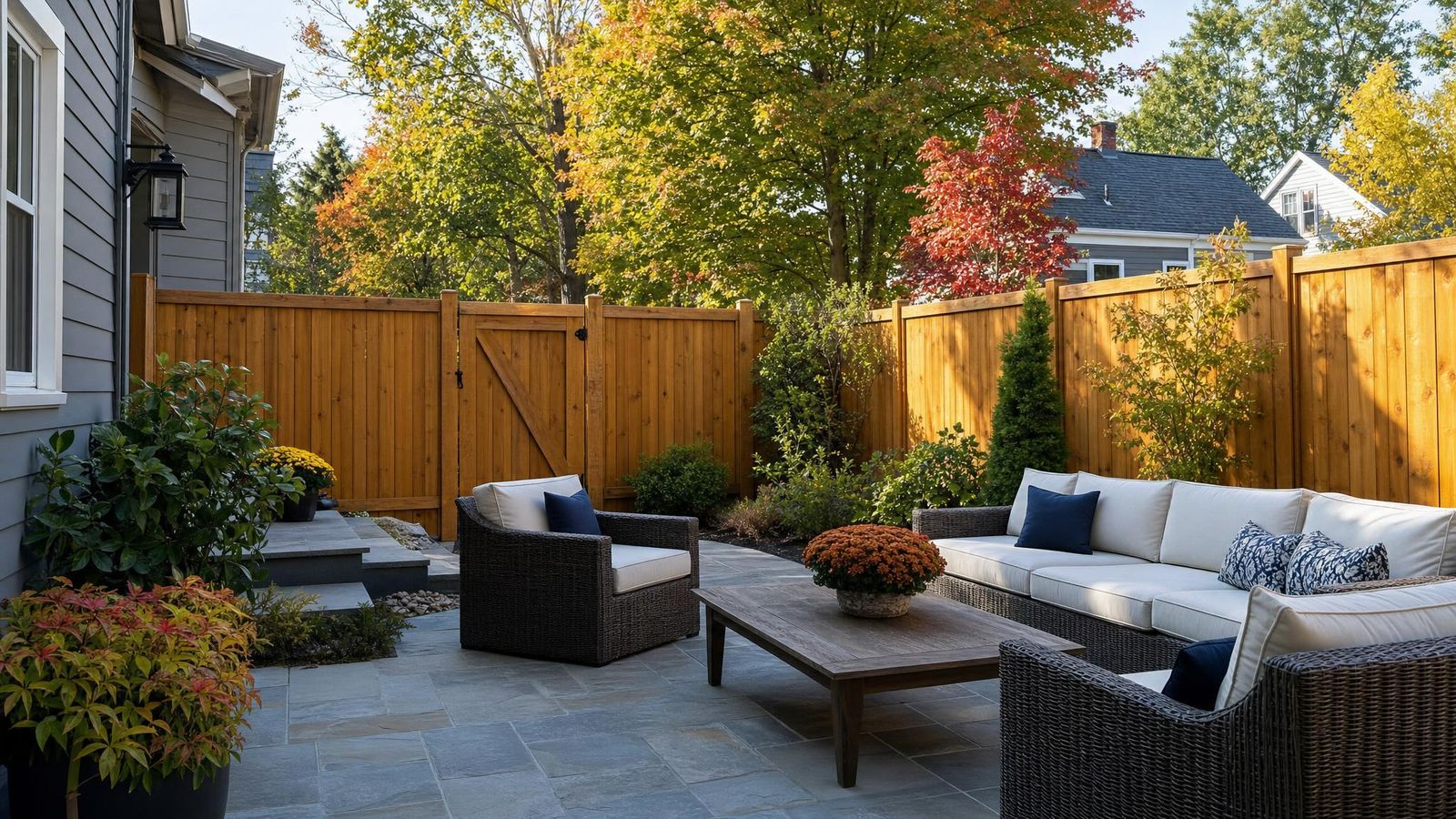
Cedar is the natural choice for a warm, traditional look and it suits the older homes around the center of town. Cedar privacy fence gives you solid boards for a back patio or pool deck; cedar picket gives you an inviting front-yard edge or garden fence. The trade-off is upkeep. Cedar weathers to gray unless you stain it, and sealing every few years helps it last. Our guides on staining and sealing cedar and caring for cedar through Connecticut winters explain what that involves.
Vinyl
Vinyl fencing comes in white and tan only at Arrow. It does not need painting or staining and washes clean with a hose, which is why newer Colchester subdivisions favor it. It is rigid and uniform, so it can look stiff against a rustic wooded lot. See our Connecticut vinyl fence guide for an honest comparison with cedar and aluminum.

Aluminum
Powder-coated aluminum keeps the view open, does not rust, and works well around pools and along driveways. It will not give you privacy. Puppy-picket spacing keeps small dogs in. If you have a pool, read our pool fence regulations guide and confirm the barrier requirements with the town before choosing a height or gate.
Post-and-rail
Post-and-rail in cedar or locust marks a boundary or pasture without blocking sight lines, and wire mesh can be added for dogs or small livestock. More on that in the next section.
Chain link
Galvanized or vinyl-coated chain link is the practical choice for dog runs, equipment areas and utility or athletic sites. See our chain link options and costs guide for the choices in coating and gauge.
Rail and Pasture Fencing for Colchester Parcels
Beyond the village center, Colchester has acreage with horses, pony paddocks, gardens and open fields. For those, a solid privacy fence is usually the wrong tool. Rail is visible to animals, which matters for horses, and it flexes instead of snapping when something leans on it.
Wood rail comes in several builds, from a simple three-rail line to a four-rail horse enclosure with mesh on the inside. Wire mesh stops foals, small ponies and dogs from slipping between rails, and it can be added now or later. Our estate and farm rail guide and the split rail costs and styles guide cover the options.
Gates matter more than people expect
On acreage, the gate is the part you use every day. Width for a tractor or trailer, the swing direction on a slope, and whether the ground at the gate stays firm in spring all change the design. Read our gate guide before you finalize locations, and walk the route you actually drive.
Deer and gardens
If the goal is keeping deer out of a garden or orchard rather than keeping animals in, the height and the material are different. Our garden and deer fence post separates the two jobs, and we will tell you honestly when a fence will not do what you hope.
Want a firm number for your property?
What Affects the Price of a Colchester Fence
We quote after measuring because the same footage can price very differently from one lot to the next. The main drivers are:
- Footage and height. Every extra foot of length and every extra foot of height adds material and labor.
- Ground conditions. Ledge and boulders slow post setting. Soft, wet ground may call for deeper or different footings.
- Slope. Stepped or racked panels take more time than a flat run.
- Gates. A walk gate and a wide drive gate are separate small projects.
- Tree and brush clearing. A wooded line must be cleared enough to build.
- Old fence removal. Taking out an existing fence and disposing of it is a separate line item.
- Material. Cedar, vinyl, aluminum, rail and chain link each price differently, and style within each matters too.
For orientation before you call, our 2026 Connecticut fence cost guide lists installed ranges by material (roughly $15 to $55 per linear foot across all materials, a wide spread that shows how much the choices matter). Treat any online range as a rough guide and ask for a written quote based on your actual lot. We also offer financing if you prefer to spread out the cost.
How an Arrow Estimate Works in Colchester
1. You call or send a request
Tell us the address, what you want to enclose, and any concerns such as a dog, a pool or a neighbor. Use the contact page or call (860) 267-6636.
2. We walk the actual line
Someone from our team looks at the grade, the likely ledge and roots, gate locations and where utilities and wet areas are. A visit usually takes about 30 minutes, with no pressure and no obligation.
3. We talk about material, height and rules
This is the honest part of the conversation. If a solid six-foot fence in a front yard is unlikely to be approved, we will say so. If vinyl will look wrong next to your house, we will say that too.
4. You get a written quote
The quote is based on what we measured. Our guide to questions to ask a fence contractor shows how to compare it fairly against anyone else’s.
5. Our own crew builds it
Custom pieces come from our East Hampton workshop and our own employees install the fence. Afterward we walk the finished fence with you before calling it done.
Colchester Permits, Zoning and Wetlands: What to Check
Connecticut has no single statewide fence permit rule. Height limits, setbacks and permit requirements are set by each town, often by zoning district, and they can differ for front, side and rear yards. We do not quote specific Colchester numbers here because they change; confirm current height and setback rules with the town before you order. Start with the Town of Colchester Planning & Zoning Department and ask the zoning office about your specific lot and fence height. Our Connecticut fence permit guide lists the questions worth asking.
- Confirm your property line. Fences go on your own land. If pins are missing or the line is disputed, get a survey first. Our property line and neighbors guide explains the practical steps, and Connecticut has a statute chapter on fences between neighbors that you can read directly.
- Ask about wetlands. If the fence will run near a brook, pond or wet area, an inland wetlands agency may need to review it. The state’s overview of inland wetlands and watercourses explains how that works. Ask the town before work starts, not after.
- Call before you dig. Utility mark-out is required before excavation. Read our call-before-you-dig guide and contact 811 in advance.
- Check any association or covenant rules. See our HOA fencing guide.
- Plan gates and access. Equipment, mowers and emergency access should all be able to reach where they need to go.
When a Fence Is Not the Right Choice in Colchester
Be honest about the fit
A fence is not always the answer. A solid privacy fence in a front yard may run into town height limits. Aluminum will not give you privacy. Vinyl can look out of place on a rustic or historic property. Chain link is rarely what people want to see from the street. A fence will not stop deer from a garden unless it is tall enough, and it will not solve a boundary dispute that a survey would. If the real problem is water, ledge or an uncertain property line, we would rather tell you at the estimate than sell you the wrong fence.
If you are not sure where to start, read how to choose the right fence in Connecticut and our look at privacy fence styles. If you already have a fence that is failing, repair versus replacement will help you decide whether a full rebuild is worth it.
Towns Near Colchester We Serve
We are based in East Hampton, a short drive from Colchester, and our East Hampton page covers our home town. Nearby, our Salem and Amston page covers Salem to the south and the Amston lake community to the north. To the west, our Middletown page covers the Connecticut River side of Middlesex County, and our Granby page covers the northwest corner of Hartford County. If you are in Hebron, Lebanon, Marlborough, Bozrah, Lyme or another town around us, call (860) 267-6636 and we will confirm that we serve your street.
Our other recent area pages cover Glastonbury in Hartford County, Cromwell and Portland in Middlesex County, and, across the state line, Westerly and Watch Hill, Rhode Island.
Commercial and institutional work in the area is covered on our commercial fencing page and in our guide to school, park and municipal fencing.
Family Founded
Reg. HIC.0537503
Minute Free Estimates
Frequently Asked Questions: Fence Contractor in Colchester, CT
Does Arrow Fence install fences in Colchester, CT?
Yes. Colchester is within our eastern Connecticut service area and is a short drive from our East Hampton office at 192 East High Street. Call (860) 267-6636 or use the contact page to set up a free on-site estimate.
Do I need a permit for a fence in Colchester?
Connecticut towns set their own fence rules, usually through zoning. Whether a permit is needed can depend on the height, the location on the lot and the district. Confirm with the Colchester Planning & Zoning Department before ordering, and see our permit guide.
What is the best fence for a large Colchester property with horses?
Post-and-rail in cedar or locust is the usual choice because animals can see it and it is forgiving. Wire mesh on the inside keeps foals and dogs from slipping through. A four-rail build is common for horses. See our rail fencing page and estate and farm rail guide.
Will rocky ground in Colchester raise the price of my fence?
It can. Ledge and boulders slow post setting and sometimes call for different tools or footing methods. That is why two yards with the same length of fence can quote differently, and why we look at the ground before giving a number.
What color vinyl fence do you install?
White and tan. Both colors are part of the material, so there is nothing to paint or stain. You can combine privacy panels in the back with picket panels along the street. See the vinyl fencing page.
Can you fence near wetlands or a brook in Colchester?
Possibly, but it depends on the exact location and the town. Fences near wetlands or watercourses can need review by the inland wetlands agency. Ask the town first, and we will talk through placement and materials at the estimate. See the state wetlands overview.
What is the best fence to keep a dog in on a wooded lot?
It depends on the dog. Aluminum with puppy-picket spacing works for small dogs, cedar picket with mesh for medium dogs, and a taller solid cedar or vinyl fence for jumpers and barkers. Our best fence for dogs guide covers the trade-offs.
How much does a fence cost in Colchester?
The price depends on footage, height, material, ground conditions, slope, gates and whether an old fence has to come out. We quote in writing after measuring. For a general budget range, see our 2026 Connecticut cost guide.
Ready to Talk About Your Colchester Fence?
Tell us what you want to enclose, screen or secure. We will walk your property, talk through materials and local rules, and give you a written quote, with no pressure.
CT Home Improvement Contractor Reg. HIC.0537503 · 192 East High St, East Hampton, CT 06424 · fences@arrowfenceinc.com