
Chain Link Fence in Connecticut: Options, Heights, Coatings and Cost
Choosing chain link fence Connecticut yards and businesses can live with: galvanized or vinyl-coated, how tall, how heavy, what it costs, and when to pick something else.
Chain link is the fence most people underestimate. It is the least expensive way to enclose a yard, a court or a work site, and it comes in more variations than most buyers realize. This guide covers the choices that actually change what you get: coating, height, gauge, framework, gates and cost.
In this guide
- Galvanized or Vinyl-Coated: The First Decision
- Height: Match the Fence to the Job
- Gauge, Mesh and Framework
- Top Treatments, Slats and Gates
- Chain Link Fence Connecticut Costs
- What to Have Ready for a Chain Link Quote
- When Chain Link Is Not the Right Choice
- Installation Details Worth Asking About
- Where We Install Chain Link
- Chain Link Fence Questions, Answered
- Get a Chain Link Quote Based on Your Site
Galvanized or Vinyl-Coated: The First Decision
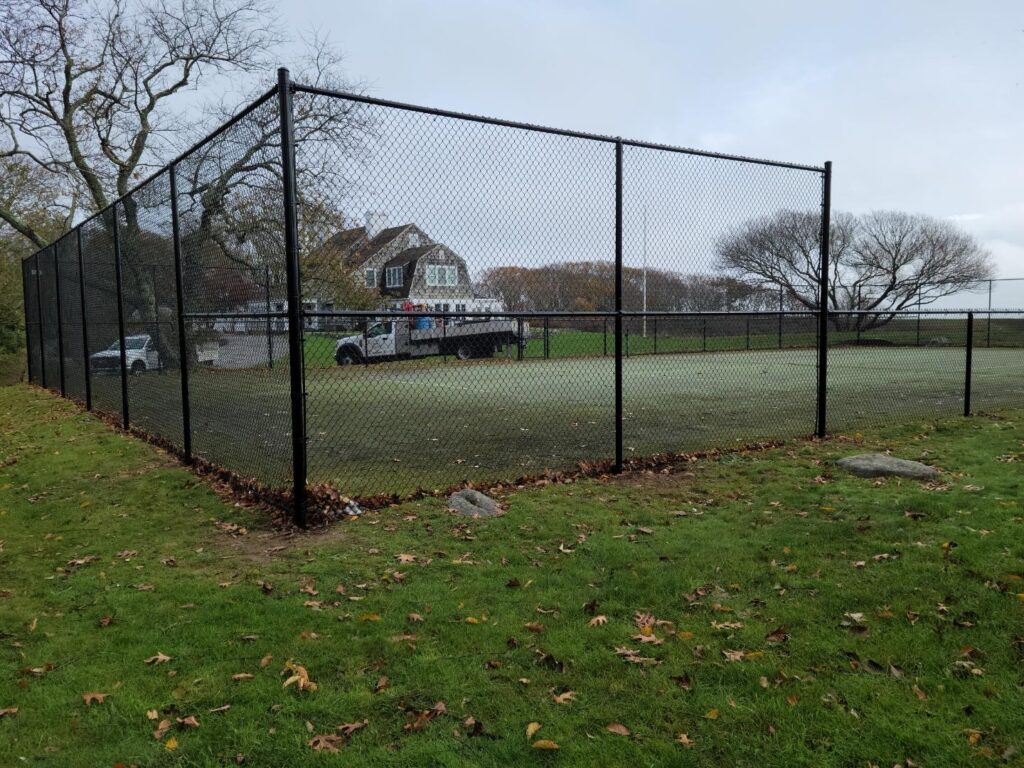
Every chain link fence starts with a steel wire fabric. Galvanized fabric has a zinc coating, giving the familiar silver-gray look. It is the lowest-cost option and the standard for industrial and utility sites. Vinyl-coated fabric has a colored polymer layer over the steel. We install black, green and brown, which fade into the background against trees, lawns and stone walls.
If you want the fence to disappear, black is the most invisible and the usual choice for courts and yards. Green and brown suit wooded settings. Galvanized makes sense when cost and function come first.


Height: Match the Fence to the Job
- 3 to 4 feet: front yards, small pets, defining a garden or lot edge.
- 5 feet: a common choice for medium and large dogs.
- 6 feet: backyards, jumpers, work yards and added deterrence.
- 8 feet and taller: industrial perimeters. Courts often go higher still. See our tennis and sports court fencing guide.
Towns set limits on height and what can be placed in front yards. Check your town’s zoning before you decide.
Gauge, Mesh and Framework
Fabric gauge is wire thickness, and a lower gauge number means thicker wire. Residential fences commonly use lighter fabric than commercial or industrial sites. Heavier fabric costs more and resists cutting and bending, which matters for security work. Ask the contractor to write down the gauge, mesh size and post size in your quote so you can compare bids.
The framework is as important as the fabric. Terminal posts, line posts, a top rail, tension wire and tension bands all carry the load. Posts should be set in concrete to a depth that gets below frost. A thin fence on well-set posts outlasts a heavy fence on shallow ones. Our frost heave guide explains why.

Top Treatments, Slats and Gates
Barbed wire tops add deterrence for commercial sites and are restricted in some zones. Privacy slats screen yards and equipment but cut visibility and catch wind. Our security fencing guide covers both in depth.
Gates are usually the highest-use part of the fence. Residential walk gates, double drive gates and heavy commercial gates all require proper posts and hardware. Our gate guide covers sizing and options.
Want a firm number for your property?
Chain Link Fence Connecticut Costs
These are the installed Hartford County ranges from our 2026 guide, which are a starting point rather than a quote.
| Item | Typical installed range |
|---|---|
| Chain link fence | About $15 to $30 per linear foot |
| Gate additions | About $400 to $1,200 per gate |
| Old fence removal | About $3 to $8 per linear foot |
| Permit fee, where required | Often $50 to $200 |
What moves the price: height, coating, gauge, terrain, rock in the ground, number of gates and whether an old fence has to come out. Chain link is typically the lowest installed cost per foot of our fence types, but vinyl coating, heavy gauge and tall heights can narrow the gap. We can discuss financing for larger projects.
What to Have Ready for a Chain Link Quote
- The purpose. Dog containment, a work yard, a court and a property boundary all lead to different specs.
- Where the line is. Know your boundary and have a survey if pins are missing.
- Gate locations and widths. Think about mowers, trucks and snow removal.
- Anything in the way. Trees, ledge, slopes, existing fence and drainage affect layout and labor.
- Rules that apply. HOA covenants, town height limits and any insurance requirements for commercial sites.
Our free estimates usually take about 30 minutes on site. You can also read what to ask a fence contractor before you compare bids.
When Chain Link Is Not the Right Choice
- You want privacy. Slats help, but cedar or vinyl are better.
- Curb appeal is the priority. Chain link is practical, not decorative. For a front yard, see our chain link vs ornamental fence comparison.
- You need pool-code compliance. Pool barriers have specific requirements, so check them with your local building official before choosing any material.
- The fence is a design feature. Aluminum or cedar will look better.
- Climbing is a concern. The mesh gives footholds. If you need a hard-to-climb barrier, ask us about alternatives.
Installation Details Worth Asking About
Two details separate a fence that lasts from one that sags. The first is how the fabric is stretched: it should be pulled tight with proper stretching tools and tied to the posts and top rail at regular intervals, not just hung loose. The second is the bottom edge. On uneven ground, the fence needs to follow the grade, and gaps under the fabric are an invitation for diggers and animals. Ask how your contractor handles slopes and where the fence meets a stone wall or a corner.
Where We Install Chain Link
We build chain link for residences, commercial and industrial sites, athletic fields and municipal properties. For a local example, see our chain link fence Simsbury page, or call 811 before any digging starts. Connecticut requires utility mark-out; you can start at Call 811. Our own crews measure, set and stretch every job.
Chain Link Fence Questions, Answered
How much does a chain link fence cost in Connecticut?
Our 2026 Hartford County guide lists about $15 to $30 per linear foot installed for chain link, with gates adding roughly $400 to $1,200 each and old fence removal about $3 to $8 per foot. Footage, height, coating, terrain and gate count change the number, so we quote after measuring. See the full cost guide.
Is galvanized or vinyl-coated chain link better?
Galvanized has a plain silver look and is the budget option. Vinyl-coated, in black, green or brown, costs more and blends into the landscape. Both are steel underneath. Choose by appearance and budget, not by an expectation that one never wears.
What height should a residential chain link fence be?
Four feet is common for front yards and small pets, five feet is common for medium dogs, and six feet adds privacy from the sightline and containment for jumpers. Check your town’s height limits first, since front yards are often held lower.
Can chain link have privacy?
Privacy slats woven into the fabric add screening, though they never block everything and they add wind load. If you want full privacy, cedar privacy fence or vinyl are better fits.
Does chain link need a permit in Connecticut?
Rules are set by your town, and a permit may be required depending on height and location. Start with our fence permit guide and call your building or zoning office.
Is chain link a good choice for dogs?
It is strong, affordable and lets dogs see out, which helps some dogs and agitates others. Diggers need an extra bottom barrier. Our best fence for dogs post compares materials.
Get a Chain Link Quote Based on Your Site
We will measure your property, review coatings, heights and gates, and give you a written price. Estimates are free and there is no pressure.
CT Home Improvement Contractor Reg. HIC.0537503