
Fence Gates in Connecticut: Types, Widths, and Why They Sag
The gate is 5% of your fence and 90% of your daily interaction with it — and it’s the first thing to fail on a cheap build. Here’s how to size, spec, and hang gates that still swing true in year fifteen.
Walk gate width for people, mowers, and trash cans
Double drive gate width for vehicles and trailers
Sag from undersized posts, not the gate itself
Latch height required on Connecticut pool gates
Size the Opening for the Life You Actually Live
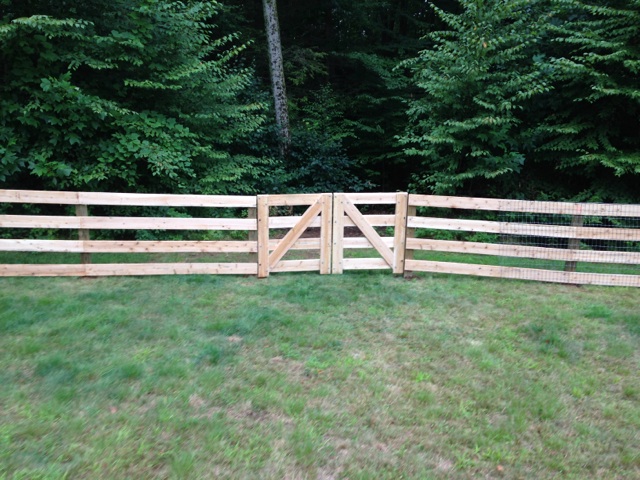
Most gate regret is width regret. A 36-inch walk gate handles people; 48 inches handles the snowblower, the wheelbarrow, and the trash cans without knuckle scrapes. If a riding mower lives in the backyard, you need 60 inches or a single-panel drive gate. And if there is any chance — ever — of a truck, mini-excavator, pool installer, or septic crew needing the backyard, an 8–12 foot double drive gate costs far less to build now than any project premium you’ll pay later for “no equipment access.”
Our rule with clients: walk the property and list everything that moves through the fence line in ten years, not ten days. The gate plan falls out of that list.
Why Gates Sag — and How Ours Don’t
A gate is a lever that hangs its full weight off two hinges bolted to one post, twenty thousand swings a decade. Sag comes from four places, in order of frequency:
- Undersized or shallow-set hinge posts. The single biggest cause. Gate posts need to be heavier than line posts and set below Connecticut’s 42–48 inch frost line in properly footed holes — a heaved hinge post takes the gate out of square by spring.
- No diagonal bracing. Wood gates need a compression brace or tension rod running the right direction; without one, the frame parallelograms.
- Hardware that came with the panel. Light strap hinges on a heavy cedar gate are a countdown timer. We hang heavy gates on through-bolted, adjustable hardware.
- Green lumber shrinkage. A gate built tight from wet pressure-treated stock develops gaps and rack as it dries. Cedar and properly dried stock behave.

Local Expert Tip: Latches Are a Winter Decision
Choose a latch you can work with gloves on, because January exists. Gravity latches with large paddles beat fiddly thumb latches in New England, and anything with a spring should be stainless — salted slush kills plain steel springs in a few seasons.
Special Duty: Pool Gates and Pet Gates
Pool gates are their own legal category in Connecticut: self-closing, self-latching, opening away from the pool, latch release at 54 inches. They fail more inspections than any other fence element — details in our pool fence options guide. Pet gates borrow the same hardware for different reasons: a self-closing hinge means the gate a kid or landscaper leaves open closes itself before the dog notices. Bottom clearance should be set for your smallest animal — the reasoning is in our dog fencing guide.
Matching the Gate to the Fence
Every fence style we install has a gate vocabulary: board and picket gates for wood privacy runs, framed-mesh gates for garden and pool enclosures, matching panel gates for aluminum and vinyl systems, and farm-style double gates for rail fencing — including drive gates wide enough for a trailer of hay or a plow truck. Arbors over walk gates remain the single most photographed thing we build; if the front walk gate is the handshake of the property, an arbor is the firm one.
Gates That Swing True for Decades
Arrow Fence Inc builds and hangs walk gates, drive gates, pool-code gates, and custom arbors across Farmington, Canton, Avon, Simsbury, and Hartford County — on posts set to outlast New England winters.