
Fence Contractor in Glastonbury, CT Pool Fences, Privacy, Picket, Rail and More
Glastonbury homeowners ask us for pool enclosures, backyard privacy, picket fences for older homes and deer protection. We have been building fences in Connecticut since 1979, with our own crews.
In this guide
- A Fence Contractor Glastonbury CT Homeowners Can Call Directly
- Glastonbury Terrain: River Valley, Hills and Farmland Edges
- Pool Fences in Glastonbury: Aluminum and Other Options
- Privacy Fencing for Glastonbury Backyards
- Deer, Gardens and Farmland Edges
- Picket Fences and Older Glastonbury Homes
- What a Glastonbury Fence Costs: Honest Ranges and Drivers
- Fence Styles at a Glance for Glastonbury Homes
- Glastonbury Zoning, Permits and Wetlands
- How an Arrow Estimate Works in Glastonbury
- When a Fence Is Not the Right Choice
- Towns Near Glastonbury We Serve
- Frequently Asked Questions: Fence Contractor in Glastonbury, CT
- Ready to Plan Your Glastonbury Fence?
Quick answer: what fence works best in Glastonbury, CT?
It depends on the job. Powder-coated aluminum is the usual pick around pools, cedar or vinyl privacy suits backyards and patios, cedar picket fits older village-style homes, and rail or taller deer fencing handles farmland edges and gardens. Arrow Fence Inc. installs all of them in Glastonbury.
We are a family-owned Connecticut contractor (HIC.0537503) with free on-site estimates. Call (860) 267-6636 or request an estimate, and confirm height and setback rules with Glastonbury’s zoning office before you order.
A Fence Contractor Glastonbury CT Homeowners Can Call Directly
Glastonbury is a large Hartford County town on the east bank of the Connecticut River, with a mix that few towns match: older village streets, big-lot suburban neighborhoods, working farmland, orchards and wooded hills. The right fence on a Main Street colonial is not the right fence on a three-acre lot in the south end of town, and a good contractor should say so.
Arrow Fence Inc. is a family company that has installed fences since 1979. Stephen Howard founded it, and his wife Maura Howard serves as president. Our own employees measure, quote and build, and custom pieces come from our East Hampton workshop. We install aluminum, vinyl, cedar privacy, cedar picket, post-and-rail and chain link, plus commercial fencing.
On this page we focus on what Glastonbury homeowners ask about most: pools, privacy, deer, historic streetscapes and what changes when your lot sits near the river. Browse the gallery to see finished work, or jump to the section that matches your project.
Glastonbury Terrain: River Valley, Hills and Farmland Edges
The western side of town drops toward the Connecticut River, where the land is generally flatter and the soil can be softer and wetter. Moving east, the ground rises into rolling hills where stone and ledge become more common. Between the two you will find streams, ponds and low pockets that stay wet into spring.
That variation shows up in fence work in three ways.
Soft, wet ground
On low, flat lots, posts are easier to dig but can shift if the soil stays saturated. We pay attention to drainage, and wood that sits close to wet ground rots faster. Where water is a chronic problem, vinyl or aluminum often outlasts wood. Our post depth and frost heave guide explains why footings must reach below the frost line, which in Connecticut is roughly three feet.
Ledge and stone on the hills
On higher ground, posts that should take minutes may take much longer if the crew hits rock. That is why we look at the ground before quoting rather than giving a flat number over the phone.
Slope
Many Glastonbury yards slope toward a pool, a pond or a stream. Panels on a slope are stepped or racked, and the choice affects both look and cost. A solid cedar or vinyl fence usually looks cleaner stepped; open aluminum follows a gentle slope easily.
Pool Fences in Glastonbury: Aluminum and Other Options
Pools are one of the most common reasons Glastonbury homeowners call us. A pool fence is a safety barrier, so the rules matter as much as the look. Barrier height, gate type, latching and spacing between pickets are all governed by building code, and your town’s building official decides what applies to your pool. Do not rely on a general article, including ours, for the final numbers. Our pool fence regulations guide and pool fence options post explain what to ask the town.
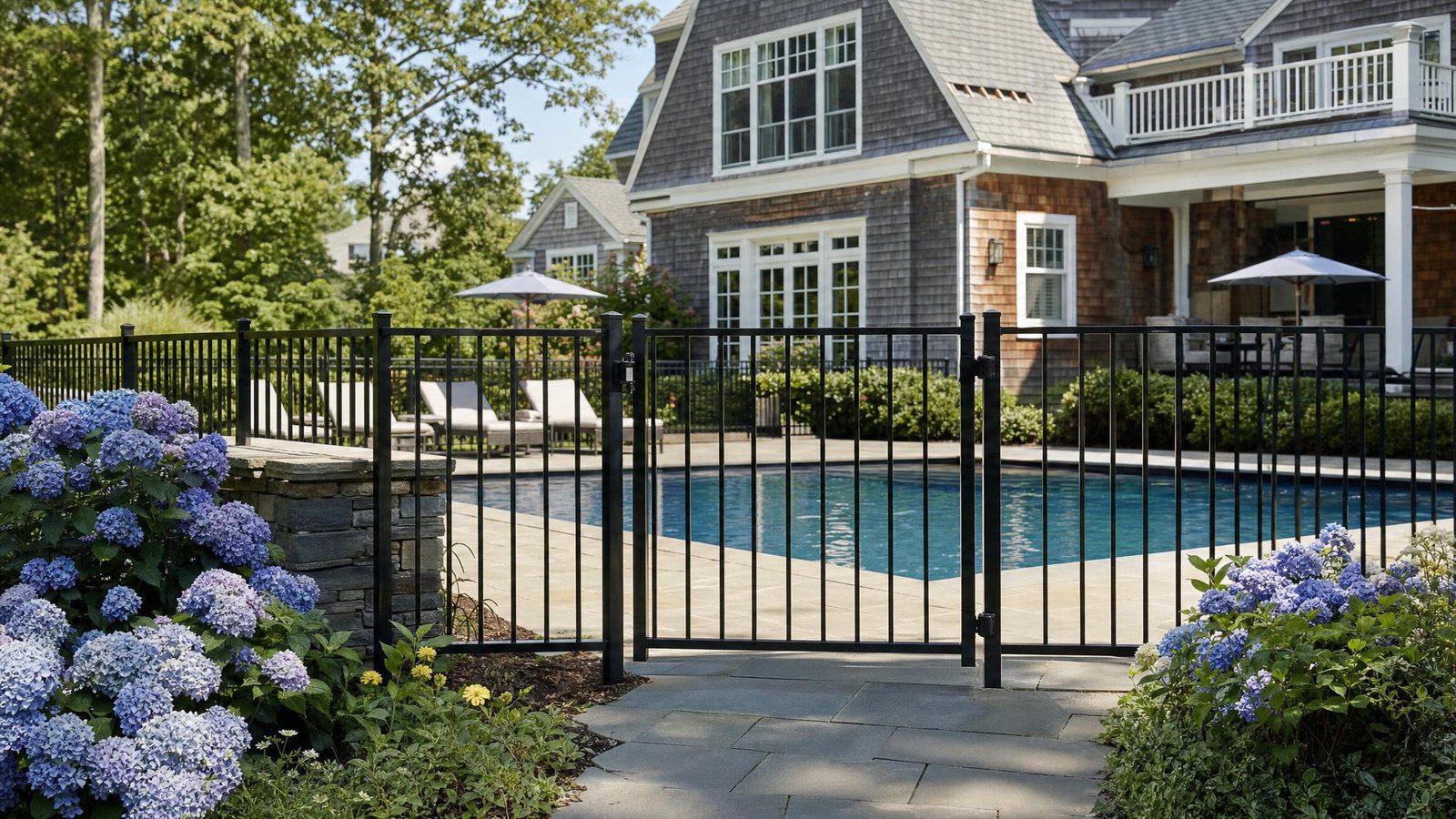
Why aluminum is the common choice
Aluminum is open, so you can see the pool from the house. It is powder-coated, so it does not rust, and it handles Connecticut winters well. Puppy-picket spacing closes the lower gaps for small children and dogs. A self-closing, self-latching gate is the standard approach.
When privacy matters
If you also want to screen the pool from neighbors, aluminum alone will not do it. Some owners put aluminum around the pool itself and run cedar or vinyl privacy along the property line. A full vinyl or cedar enclosure is possible too, with a latching gate, and the building official will tell you what must be confirmed.
Plan the gate first
Where people enter, how the gate swings and where it latches decide whether the fence is safe and convenient. Our gate guide goes through the options.
Privacy Fencing for Glastonbury Backyards
In established neighborhoods the property line is often 80 or 100 feet from the patio, so privacy fencing is frequently about one specific sightline: a neighbor’s second-floor window, a road, a pool deck. We often recommend building less fence than people first picture, placed where it does the most good.
Cedar privacy
Cedar privacy fence brings warmth and suits wooded lots and older homes. It needs staining or sealing now and then; see our guides on staining cedar and winter care.
Vinyl privacy
Vinyl in white or tan needs no painting and washes with a hose. It suits newer homes and sunny yards. In deep, permanently damp shade it will still hold up but can show green algae that needs occasional cleaning.

Mixing privacy with open sections
A common design is solid privacy panels around the patio, stepping down to a lower picket or aluminum section along the front or the driveway. Our privacy fence styles guide shows the variations.
Deer, Gardens and Farmland Edges
Glastonbury still has farms, orchards and open fields, and deer are a fact of life across the town. A garden fence that keeps rabbits out is a different structure from one that keeps deer out, and the difference is mostly height and visibility.
For vegetable beds and small gardens, a low cedar or aluminum fence defines the space and keeps dogs and small animals out. For deer, you need a taller barrier, and the material has to be nearly invisible or very solid. Our garden and deer fence guide is candid about where fencing helps and where it does not, and we will tell you if your goal is unrealistic for the budget.
For pastures, paddocks and field edges, post-and-rail in cedar or locust is a classic fit, with wire mesh added where small animals or dogs are involved. Our estate and farm rail guide covers the choices.
Want a firm number for your property?
Picket Fences and Older Glastonbury Homes
Glastonbury has many older homes, and a front fence should look like it belongs to the house. Cedar picket in a classic pattern is the traditional answer; black aluminum with a restrained top rail is an alternative that needs no repainting. Avoid fences that are too tall or too heavy for the lot, since they make the house feel smaller.
If your house is in or near a locally designated historic district, ask the town whether a review applies before you choose a style. Not every older street is in a district, and the town can tell you in one phone call. If it does apply, the review may influence materials and design, and it is better to know up front than after the posts are set.
Front-yard fences are also the ones most likely to be limited by height. Check first, then choose.
What a Glastonbury Fence Costs: Honest Ranges and Drivers
Pricing depends on your lot, so we quote in writing after measuring. For orientation, our Hartford County fence cost guide puts installed fencing in Hartford County at roughly $22 to $45 per linear foot in 2026, with cedar privacy at about $28 to $45 and a 4-foot cedar picket at about $18 to $28. Your own number depends on these drivers:
- Total footage and height. Larger lots mean more fence, and taller fences use more material.
- Material and style. Aluminum, vinyl, cedar and rail each price differently, and custom styles cost more.
- Slope, ledge and wet ground. Hard digging and drainage add labor.
- Gates. A drive gate or a pool-code gate adds cost.
- Clearing and removal. Brush clearing and old fence removal are separate items.
Our 2026 Connecticut cost guide covers statewide ranges by material, and our financing page explains how to spread the cost out.
Fence Styles at a Glance for Glastonbury Homes
| Fence | Best for in Glastonbury | Watch out for |
|---|---|---|
| Aluminum | Pools, driveways, open yards | No privacy; confirm pool rules with the town |
| Cedar privacy | Patios, wooded lots, older homes | Needs sealing or staining; keep wood off wet ground |
| Vinyl privacy | Newer homes, low-maintenance yards | Only white or tan; can look stiff on rustic lots |
| Cedar picket | Front yards, gardens, historic streets | Front-yard height limits |
| Post-and-rail | Fields, paddocks, large lots | Add mesh if small animals or dogs are involved |
| Chain link | Dog runs, utility areas, sports courts | Rarely suited to a visible front yard |
Unsure how to choose? Our guide on choosing the right fence in Connecticut walks through the decision, and the vinyl fence guide gives a side-by-side with wood and aluminum.
Glastonbury Zoning, Permits and Wetlands
Connecticut towns set their own fence rules, usually through zoning, and they can differ by district and by which side of the house the fence is on. We do not quote Glastonbury numbers on this page. Confirm the current height and setback rules for your lot with the zoning office, which you can reach through the Town of Glastonbury Building Inspection and Zoning page. That page links to the Building Zone Regulations and to building permit information. Our Connecticut fence permit guide lists the questions to ask.
- Wetlands and the river. Land near brooks, ponds, wetlands or the Connecticut River may be subject to review. The town’s wetlands and natural resources page is the place to start.
- Property lines. Fences go on your land. If markers are missing, get a survey. See our property line guide and the state’s chapter on fences.
- Utilities. Contact 811 before digging; read our guide.
- Associations. If you live in a community with covenants, see our HOA fencing guide.
How an Arrow Estimate Works in Glastonbury
The process is straightforward. You contact us. Someone from our team visits, usually for about 30 minutes, to walk the line, check the grade, find the gate locations and note anything that complicates the work such as ledge, roots or a wet corner. We then talk through materials, heights and the local rules that apply to your lot, and we send a written quote. If you accept, our own crew builds the fence, and we walk it with you at the end. Our list of questions to ask any fence contractor is worth reading before you compare quotes.
When a Fence Is Not the Right Choice
Be honest about the fit
A tall privacy fence at the front of a lot may run into height limits. Aluminum will not screen a view. Vinyl may look wrong on a historic house. A fence will not stop a determined deer without enough height, and it cannot fix a drainage problem that will eventually undermine the posts. If the property line is unclear, order a survey first. We would rather say so at the estimate than sell you something that disappoints you.
If you already have a fence that is failing, read repair versus replacement to decide whether a rebuild is the right move.
Towns Near Glastonbury We Serve
Glastonbury is in Hartford County, and we work throughout it. Nearby pages cover Middletown to the southwest, Cromwell and Portland along the river to the south, East Hampton, our home town, to the southeast, Colchester to the east and Avon in the Farmington Valley. If you are in a neighboring town such as Marlborough, Hebron or Portland, call (860) 267-6636 and we will confirm that we serve your street.
Family Founded
Reg. HIC.0537503
Minute Free Estimates
Frequently Asked Questions: Fence Contractor in Glastonbury, CT
Do you install fences in Glastonbury, CT?
Yes. Glastonbury is in Hartford County, which is part of our service area. Call (860) 267-6636 or use the contact page to set up a free estimate on your property.
What fence is best around a pool in Glastonbury?
Powder-coated aluminum is the usual choice because it is open, does not rust and can be built with puppy-picket spacing and a self-closing, self-latching gate. Barrier height and gate rules come from building code, so confirm them with Glastonbury’s building official. See our pool fence regulations guide.
How tall does a fence need to be to keep deer out?
Taller than most people expect. A standard backyard fence will not stop deer, which can jump high, so deer protection usually means a significantly taller barrier or a design that discourages jumping. Our garden and deer fence guide covers realistic options, and we will tell you if your goal is not practical.
Do I need approval before building a fence in a Glastonbury historic district?
If your house is in a locally designated historic district, ask the town whether a review applies before you choose a design. Not all older homes are in a district. Contact the town’s building and zoning office to confirm.
Is vinyl or cedar better for a Glastonbury backyard?
Vinyl needs almost no upkeep and comes in white or tan. Cedar looks warmer and more natural but needs periodic staining or sealing. Cedar tends to suit wooded lots and older homes; vinyl suits newer homes and low-maintenance yards. See our vinyl guide and cedar page.
Will a fence near wetlands or the river need extra review?
It can. Land near wetlands, streams or the river may be regulated, and some fence work near them needs review. Ask the town before work starts. Glastonbury’s wetlands page is a good starting point.
How much does a fence cost in Glastonbury?
Our Hartford County cost guide lists installed ranges of roughly $22 to $45 per linear foot in 2026. Your price depends on footage, height, material, ground, gates and removal of an old fence, so we quote after measuring.
Can you combine two fence types on one Glastonbury property?
Yes. Many projects mix materials, such as aluminum around a pool and cedar privacy along a side line, or vinyl in the back with picket in front. We can plan and install them as one job so the pieces look like they belong together.
Ready to Plan Your Glastonbury Fence?
Tell us what you want to protect, screen or define. We will walk your property, talk through materials and local rules, and give you a written quote with no pressure.
CT Home Improvement Contractor Reg. HIC.0537503 · 192 East High St, East Hampton, CT 06424 · fences@arrowfenceinc.com