
Vinyl Fence in Connecticut: What to Know Before You Buy
Vinyl is what people choose when they are tired of staining. Here is how a vinyl fence in Connecticut handles winter, wind and everyday life, which color to pick, and the yards where another material is a better call.
In this guide
- What a Vinyl Fence Is, and What Arrow Installs
- White or Tan: Choosing the Color
- Vinyl Fence Connecticut Winters: Cold, Snow and Frost
- What Maintenance Really Looks Like
- Vinyl vs Cedar vs Aluminum
- Posts, Gates and Coastal Yards
- When Vinyl Is Not the Right Choice
- Before You Order a Vinyl Fence
- Vinyl Fence Questions, Answered
- Get a Straight Answer on Vinyl for Your Yard
What a Vinyl Fence Is, and What Arrow Installs
Vinyl fencing is extruded PVC: hollow posts, rails and panels that are assembled on site. The color is part of the material rather than a coat of paint, which is why there is nothing to peel. The panels we install use aluminum reinforcement inside the rails for strength. We offer two families: vinyl privacy and vinyl picket, in white and tan.
Privacy panels are solid and usually six feet tall. Picket styles run about 36 to 48 inches, with pointed, flat or scalloped tops. Many yards use both: privacy around the back, picket along the front. Walk gates and double drive gates are available in either style.


White or Tan: Choosing the Color
White is the classic. It suits colonial and cape-style homes, and it makes small yards feel bright. It also shows green mildew and dirt faster, particularly on the shady, north-facing side of a Connecticut lot, so expect a wash once or twice a year.
Tan reads warmer and sits quietly against cedar shingles, brick and earth-tone siding. It hides pollen better than white. It is a solid color, not a wood-grain imitation, so look at one in person before you decide. Stop by our East Hampton workshop to see samples, or ask for them at your estimate.
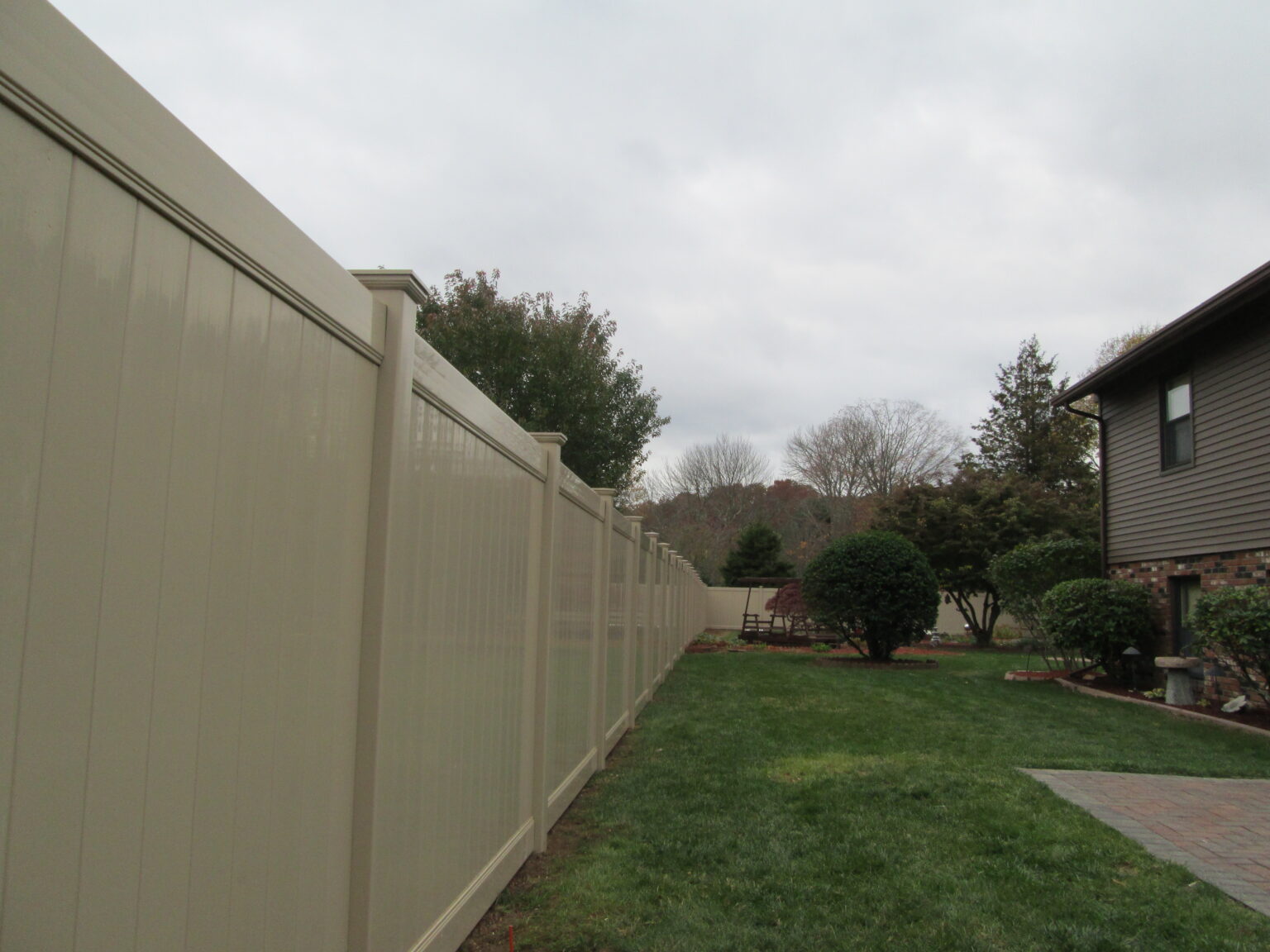
Vinyl Fence Connecticut Winters: Cold, Snow and Frost
Wood suffers in a Connecticut winter because it takes on water that freezes and thaws all season. Vinyl does not absorb water, so that failure does not apply. Three other winter issues do.
- Cold makes vinyl stiffer. A panel that flexes in July can crack from a sharp hit in January. Plow blades, snow blowers, mowers and heavy snow sliding off a roof are the usual causes.
- Solid panels catch wind and drift snow. A six-foot privacy fence acts like a sail, so post depth and spacing matter. Read how posts are set below frost depth in our guide to fence post depth and frost heave in Connecticut.
- Plowed snow piles. Do not stack plowed snow against the fence. The weight can push panels out of line.
Plain advice
Vinyl handles Connecticut weather well when the posts are set properly. Most winter problems come from impact and frozen ground, not from the material wearing out.
Want a firm number for your property?
What Maintenance Really Looks Like
There is no staining, painting or sealing. Plan on a spring rinse with a garden hose, and a soft brush with mild soap on any green mildew in shaded areas. Check gate hinges and latches once a year. Remove branches that fall on it. That is the full list. Compare that with the staining schedule in our cedar fence maintenance guide.
Vinyl vs Cedar vs Aluminum
The three materials solve different problems. The installed cost ranges below come from our 2026 Hartford County cost guide.
| Factor | Vinyl | Cedar | Aluminum |
|---|---|---|---|
| Look | Clean and uniform, white or tan | Natural wood, stain or weather | Open, ornamental, black or other powder-coat |
| Privacy | Full, with privacy panels | Full, with solid boards | None, open design |
| Upkeep | Rinse | Stain or seal every few years | Rinse |
| Installed range, Hartford County | About $30 to $55 per linear foot | About $25 to $45 per linear foot | About $28 to $50 per linear foot |
| Best for | Low-maintenance backyards, patios, pools with privacy | Warm, traditional or rustic settings | Pools, front yards, views |
| Watch out for | Impact in deep cold, hard to attach things to | Upkeep and damp shade | No privacy |
If you are still undecided, our guide to choosing the right fence walks through the decision, and the cedar privacy and aluminum pages show finished work.

Posts, Gates and Coastal Yards
The fence is only as good as what holds it up. Posts have to be set deep enough for frost and sized for the panel height, and the gates are the part that gets used every day. A vinyl gate is heavy, so it needs proper hardware and a post that will not lean, or it will sag and drag within a couple of seasons. Ask any contractor how the gate posts are set and what hardware they use.
Vinyl does not rust or rot, which is why it works near salt water. If your property is on the shoreline, our guide to coastal and shoreline fence materials compares options for salt air and wind. Along a wooded property edge, expect needles, leaves and pollen to build up and plan the occasional rinse.
When Vinyl Is Not the Right Choice
- Historic or rustic settings. If the house or neighborhood calls for real wood, cedar will look right where vinyl will not.
- Steep ground. Rigid panels step down a slope in visible stairs. Aluminum or cedar often follows steep grade more cleanly.
- Anything you want to paint, stain or attach. Vinyl is hard to fasten into and should not be painted.
- Dark colors. We install white and tan only.
- An HOA that specifies wood or metal. Check the covenants before you order.
Honestly, if you want maximum privacy and zero upkeep, vinyl is a strong answer. If you want warmth, character, or an open look, it is not.
Before You Order a Vinyl Fence
- Confirm your property line, and get a survey if pins are missing.
- Check town rules on height and setbacks, and whether a permit is needed. Start with our permit guide.
- Call 811 before digging, which Connecticut requires before posts go in.
- Verify any contractor’s registration through the state’s eLicense system. Ours is HIC.0537503.
- Ask whether financing is available if you want to spread the cost.
Serving the Farmington Valley? See our Avon fence contractor page.
Vinyl Fence Questions, Answered
How long does a vinyl fence last in Connecticut?
Vinyl does not rot, rust or absorb moisture, so age is rarely the problem. Damage usually comes from impact, wind or settling posts. Manufacturers publish their own warranty terms, so ask to see the written terms for the product you are being quoted.
Does vinyl fence crack in cold weather?
It can be more brittle in deep cold than in summer, so a hard hit from a plow, a mower or a sliding snow bank is more likely to crack a panel in January than in July. Normal winter weather alone does not harm it, but keep plowed snow from being piled against the fence.
Can I get a vinyl fence in colors other than white and tan?
Not from us. Arrow installs vinyl in white and tan only. If you want a dark or custom color, powder-coated aluminum or stained cedar are better answers.
Is vinyl cheaper than cedar?
Usually not up front. Our 2026 Connecticut cost guide lists Hartford County installed ranges of about $30 to $55 per linear foot for vinyl privacy and $25 to $45 for cedar privacy. Vinyl can narrow the gap over time because it skips staining. Your actual price depends on footage, terrain and gates.
Do I need a permit for a vinyl fence?
Many Connecticut towns regulate fence height and placement, and some require a permit. Check with your building or zoning office first. Our permit guide explains what to ask.
Can vinyl be used as a pool fence?
It can be configured to meet pool enclosure rules with the right height and a self-closing, self-latching gate, but code requirements vary. Confirm the requirements with your local building official before you order.
Get a Straight Answer on Vinyl for Your Yard
We will measure your property, show you white and tan options, and tell you honestly whether vinyl, cedar or aluminum fits best. Estimates are free.
CT Home Improvement Contractor Reg. HIC.0537503