
Privacy Fence Styles for Connecticut Yards
Not all privacy fence styles work the same way. Here is a plain comparison of tongue-and-groove, board-on-board, stockade, semi-privacy, horizontal and vinyl, with the Connecticut trade-offs for each.
Privacy fence styles look similar from the street and behave very differently in a Connecticut yard. Some block every sightline from both sides. Some let air through so the fence survives a nor’easter. Some cost more up front but need less work later. This guide compares the main styles Arrow Fence builds and installs, in plain terms, so you can pick the one that fits your lot, your neighbors and your patience for upkeep.
In this guide
- Start With Three Questions
- Privacy Fence Styles Compared
- Tongue-and-Groove: The Tightest Privacy
- Board-on-Board: Privacy With Room to Move
- Stockade: The Simple Boundary
- Semi-Privacy and Alternating Boards
- Horizontal Board Fences
- Vinyl Privacy: Low Upkeep
- How Style Affects Upkeep and Cost
- Details That Matter More Than Style
- Privacy Fence Styles FAQ
- Not Sure Which Privacy Fence Style Fits?
Start With Three Questions
- How private is private? Total seclusion from a neighbor’s deck is a different job than screening a driveway or a pool.
- Who sees the good side? Many towns expect the finished face outward. Granby, for example, says the finished side of a fence within 10 feet of a property line must face outward (town FAQ). Style affects whether both sides look finished.
- How much upkeep will you really do? Cedar can be left to weather or stained; vinyl needs a rinse. Be honest.

Privacy Fence Styles Compared
| Style | Privacy | Both sides finished? | Wind | Best for |
|---|---|---|---|---|
| Tongue-and-groove cedar | Total, no gaps even as boards dry | Same face on both sides is typical for this style | Solid, catches wind | Pools, patios, tight lots |
| Board-on-board cedar | Total from most angles, overlapped boards | Yes, both sides look alike | Solid, catches wind | Yards with neighbors close |
| Stockade cedar | High, simple panels or boards | Often one finished face | Solid | Boundaries on a budget |
| Semi-privacy cedar | Partial, blocks direct views | Usually yes | Lets some air through | Windy sites, long runs, light and air |
| Horizontal board cedar | High, modern look | Depends on build | Solid | Contemporary homes |
| Vinyl privacy (white or tan) | Total, solid panels | Yes | Solid, depends on post setting | Low-upkeep backyards |
Details vary with how a fence is built, so treat the table as a starting point. We confirm the construction when we quote.
Tongue-and-Groove: The Tightest Privacy
Tongue-and-groove boards interlock, so when cedar dries and shrinks, the gaps stay closed. That makes it the style people choose around pools and patios, where even a thin sightline is annoying. It is also quieter than a gappy fence, because solid cedar reduces some noise from neighbors and roads. The trade-off is wind load. A solid panel acts like a sail, so post depth and post spacing matter more here than on any other style. Read our guide to privacy cedar fencing and the how to choose the right fence guide for the full picture.
Board-on-Board: Privacy With Room to Move
Board-on-board uses overlapping boards, so the fence looks solid from nearly every angle but leaves tiny gaps between layers. Wood moves with humidity and Connecticut’s freeze-thaw swings, and this build tolerates that movement better than butted boards. It looks finished from both sides, which helps with neighbor relations. It uses more lumber than a simple stockade, and our cost guide on cedar privacy fence costs explains how height and profile drive pricing.
Stockade: The Simple Boundary
Stockade is the classic backyard fence: upright boards on rails, usually with a finished face on one side. It is straightforward and works well when the goal is to define a boundary, hold a dog, or block casual views. It is not the best choice if you want a polished look from both sides or a perfectly gap-free screen.
Semi-Privacy and Alternating Boards
Semi-privacy designs, such as alternating boards on both sides of the rails, block direct views while letting air and light pass. Wind goes through instead of pushing on the whole fence, so these are practical on exposed hilltops and long runs. They are also a good fit for yards that already feel closed in. You will see a few semi-privacy builds in our fence gallery.

Horizontal Board Fences
Horizontal boards give a clean, modern line and suit contemporary houses. They show every board end and joint, so craftsmanship matters, and long horizontal spans need rails and posts planned to resist sagging. Ask us about the build before you commit, because horizontal designs are more custom than a standard panel.
Vinyl Privacy: Low Upkeep
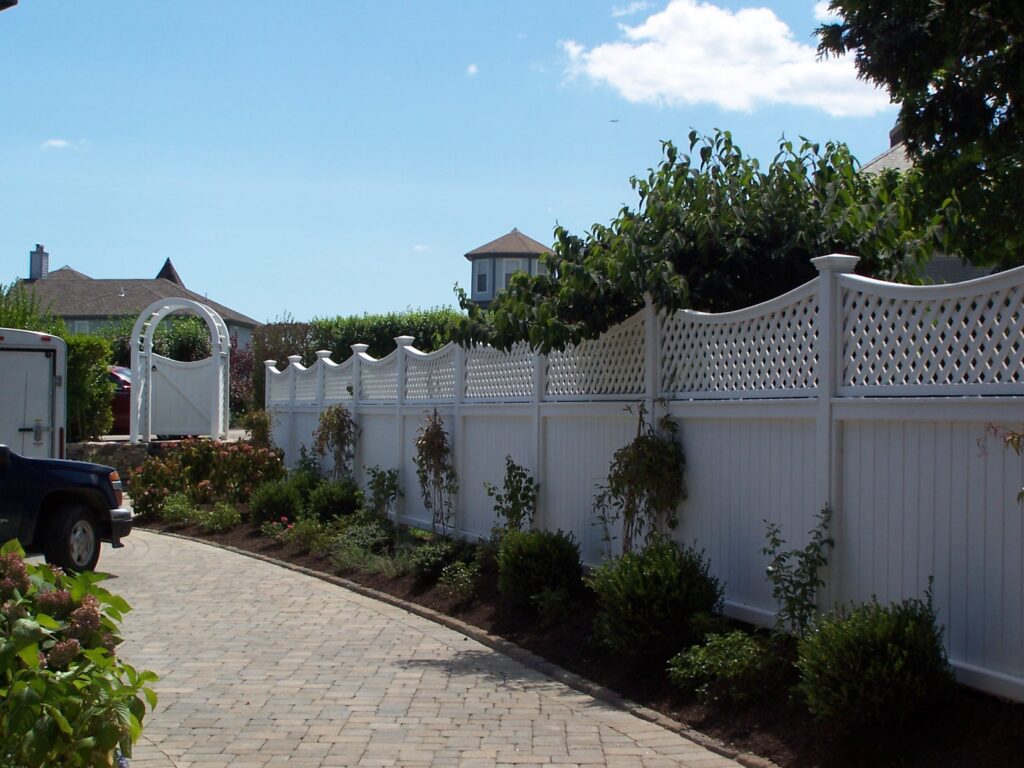
Vinyl privacy fencing comes in solid panels in white or tan, with no staining, painting or sealing. If upkeep is what you want to avoid, it is usually the best answer. The trade-offs are a more uniform look than natural wood and a limited color choice. See vinyl fencing for what we install, and read the stain guide in how to stain and seal a cedar fence if you are weighing cedar against it.
Want a firm number for your property?
How Style Affects Upkeep and Cost
Style changes what you pay and what you maintain. Interlocking and overlapped builds use more material than a simple stockade, and taller or custom-topped designs take more fabrication time. On the upkeep side, vinyl needs the least, cedar needs a stain or sealer decision, and every solid style benefits from keeping soil, mulch and sprinklers off the bottoms of the boards. For a deeper look at the vinyl option, read our vinyl fence buyer’s guide. We would rather talk you out of an expensive style that does not suit your yard than sell it to you.
A solid fence can trap shade on a garden bed, hold snow drift against one side, and block a view you will miss. If you mainly need to contain pets or mark a boundary, a picket fence costs less and feels friendlier. If it surrounds a pool, you also need to meet pool-code requirements, so read our pool fence regulations page. For pool spacing, aluminum fencing is built for it.
Details That Matter More Than Style
- Height. Our cedar privacy fences range from 4 to 8 feet. Taller means more wind load and often more rules, so check with your town. Our fence permit guide covers how that works in Connecticut.
- Toppers. Lattice, spindle and scalloped tops add light and style, and break up a tall wall.
- Gates. Plan them early. See our fence gate guide.
- Utilities. Know where lines run before anyone digs. Click Before You Dig is Connecticut’s free marking service.
- Terrain. Slopes call for stepped or racked panels. We cover this when we walk your yard.
Looking at a project near Granby or Simsbury? See our Granby fence contractor page or Simsbury page.
Privacy Fence Styles FAQ
What is the most private fence style?
Tongue-and-groove cedar and vinyl privacy panels are the most private, since they have no gaps. Board-on-board is nearly as private from most angles.
Which privacy fence style handles wind best?
Semi-privacy styles let air pass and carry less wind load. Solid fences can work in windy areas, but post depth and spacing need to be right.
Do both sides of a privacy fence look the same?
It depends on the style. Board-on-board and vinyl panels usually look finished from both sides. Stockade often has one finished face. Many towns want the finished side outward near the property line, so check yours.
How tall can a privacy fence be in Connecticut?
Rules are set by each town and its zoning, so there is no single answer. Arrow builds cedar privacy fences from 4 to 8 feet. Check with your town before choosing a height.
Is vinyl or cedar better for privacy?
Both give total privacy. Vinyl needs almost no upkeep and comes in white or tan. Cedar gives a natural look and many design options, and can be stained or left to weather.
How do I get a price on a privacy fence?
Pricing depends on footage, height, style, terrain and gates. Arrow quotes after measuring. Our cost guides give general ranges, and you can request a free estimate on our contact page.
Not Sure Which Privacy Fence Style Fits?
Tell us what you want to block, what you want to keep, and how much upkeep you will accept. We will visit your property, measure, and recommend a style honestly.
CT Home Improvement Contractor Reg. HIC.0537503