Fence Contractor Salem CT Rural Land, Lake Lots and Horse Country
A family-run fence company since 1979. We fabricate in our East Hampton workshop and install with our own crews, with no subcontractors, from Salem to the Colchester, Lebanon and Hebron lines.
- Since 1979
- In-house crews
- Salem · Amston · Colchester · Lebanon · Hebron
- CT Reg. HIC.0537503
In this guide
- A New London County Fence Company That Understands Salem Land
- What Makes Fencing in Salem Different
- Horse, Farm and Pasture Fencing
- Lake-Area Homes: Gardner Lake and Amston
- Common Fence Projects Around Salem
- Materials That Make Sense in Salem
- Fencing the Colchester, Lebanon and Hebron Edge
- Rules, Wetlands and Utilities Before You Build
- How a Salem Fence Project Works With Arrow
- Fence Contractor Salem CT: Common Questions
- Ready to Fence Your Salem Property?
A New London County Fence Company That Understands Salem Land
If you are looking for a fence contractor in Salem, CT, the first thing to know is that Salem is not a subdivision town. It covers about 30 square miles of hills, wetlands and open fields, with a population of just over 4,000 at the 2020 census. Properties here tend to be larger, more wooded and rockier than the lots we fence in the Hartford suburbs. A fence that works on a flat quarter-acre in town can fail quickly on a sloped, ledgy acre and a half off Route 82.
Arrow Fence is a New London County fence company in the practical sense: we are based in East Hampton, just up the road, and we have been building fences for Connecticut homeowners, farms and businesses since 1979. This page covers how we approach Salem and the neighboring Amston, Colchester, Lebanon and Hebron properties, what we build, and what to check before you sign anything with any contractor.
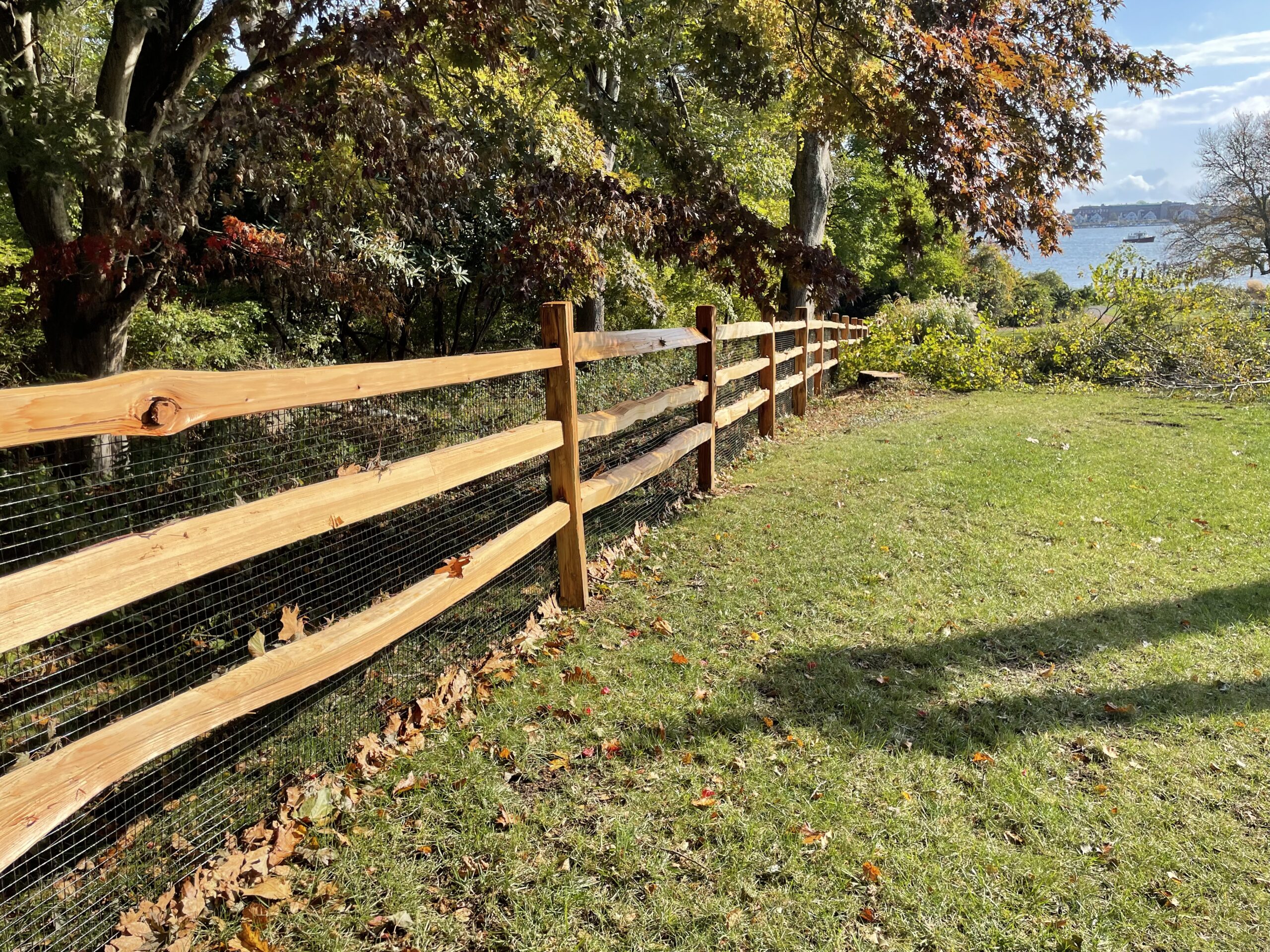
Cedar split rail with wire mesh keeps the view open and the dog in.
What Makes Fencing in Salem Different
Four conditions come up again and again on rural eastern Connecticut properties. We plan for each of them before we quote.
Ledge and rocky soil
Salem sits on hilly, rocky ground. Glacial stone and shallow bedrock mean post holes do not always dig where the layout says they should. We adjust post spacing to the land instead of forcing a pattern.
Wetlands and seasonal water
Wet meadows, brooks and lake edges are common. Soil that stays wet pushes you toward rot-resistant material and careful drainage at each post.
Slopes and long runs
Rail and chain link follow grade well; solid panels have to be stepped or racked. On long farm boundaries the choice of material matters as much as the price per foot.
Deer, dogs and livestock
Rural lots mean real wildlife pressure and animals you want kept in. Our deer fence guide covers what actually holds.
Old stone walls
Many Salem boundaries are still marked by field stone walls. We can fence along a wall, but we do not move or take down a wall to make a layout easier.
Long driveways and access
Deliveries and crews need to reach the work. Long gravel drives, narrow bridges and steep entries are things we want to see on the estimate walk.
Horse, Farm and Pasture Fencing

Salem’s agricultural heritage is still visible in its fields, and horse owners, hobby farmers and small livestock keepers are a natural fit for post-and-rail. Arrow’s rail fencing comes in western red cedar and locust, in meadow gate, estate rail and board rail styles, plus a 4-rail horse enclosure with wire mesh.
Rails give a horse a clear view of the pasture and keep the boundary open. Wire mesh on the inside stops foals, dogs and small animals from slipping through the gaps. Gates are where pasture fences fail first, so we build them to the size your tractor, trailer or hay wagon actually needs. Our fence gate guide explains width, swing and hardware choices.
When rail is not the right choice: a post-and-rail fence does not give privacy, and it will not stop deer from jumping into a garden. For a fenced vegetable garden, use a taller, tighter option. Rail is also a poor fit if you need a fence that can be left completely maintenance-free, because wood weathers.
Read more in our guide to estate and farm rail fencing in Connecticut.
Want a firm number for your property?
Lake-Area Homes: Gardner Lake and Amston
Salem has several lakes and ponds, including Gardner Lake, one of the larger lakes in southeastern Connecticut. Just across the line in Hebron, the village of Amston is built around Amston Lake, a private lake owned collectively by the Amston Lake District property owners. Lake neighborhoods like these were often built as seasonal cottages and later converted to year-round homes, so lots can be small, close together and close to the water.
On lake lots we usually see three fence jobs: a privacy fence between close neighbors, a pet or child safety enclosure, and a pool fence. Because many of these lots sit near the water, wet soil and setback rules both come into play. Each lake community may also have its own association rules, so ask before you design anything. You can read about the Amston Lake district and its shared ownership in the Connecticut Agricultural Experiment Station’s lake record.
For privacy near a lake, cedar privacy fencing and vinyl fencing (white or tan) are the two usual picks. Vinyl avoids rot in damp ground, while cedar gives a warmer look and can be stained. For pools, powder-coated aluminum is pool-code compliant, and our pool fence options guide compares the choices.
When a fence is not the right choice: if the only reason for the fence is a view you want to protect, a solid privacy fence can block the very lake view you are paying for. An open aluminum or rail fence frames a view instead of walling it off.
Common Fence Projects Around Salem
Backyard and dog fencing
Most residential calls start with a yard that backs onto woods or wetland. Dogs here meet deer, coyotes and the occasional fox, so the fence needs to be tight at the bottom and sturdy at the gate. Wood or vinyl privacy, aluminum with puppy pickets, or rail with mesh all work, depending on how much you want to see. Our best fence for dogs guide goes through each option.
Pool enclosures
A pool needs a code-compliant barrier. Powder-coated aluminum is the usual choice, and Connecticut rules on gates and heights are covered in our pool fence regulations guide. Check Salem’s own requirements before ordering.
Driveway entries and gates
Rural driveways often get a pair of cedar or aluminum gates at the road. Because Salem winters bring frost, snow and plow piles, gate posts and hinges need to be set to handle movement. Ask us about swing clearance and where the snow will go.
Commercial and municipal
Salem has very little commercial development, but farms, churches, contractors’ yards and town properties still need fence. Our commercial division installs all fence types for these and other customers.
Repair or replace
If you already have an old wood or rail fence, a repair may be enough. Our repair versus replacement guide will help you decide, and we will tell you honestly when a section can be saved.
Materials That Make Sense in Salem
We install cedar privacy, cedar picket, post-and-rail, vinyl, powder-coated aluminum and chain link, plus gates. Here is how they line up for typical Salem-area properties.
| Fence | Good fit in Salem for | Watch out for |
|---|---|---|
| Post-and-rail (cedar or locust) | Horse pastures, long boundaries, stone-wall properties, open land | No privacy; mesh needed for small animals |
| Cedar privacy | Backyards, neighbor screening, pool-adjacent yards | Needs staining; slopes require stepping |
| Cedar picket | Front-yard cottages, gardens, traditional New England look | Not a barrier for deer |
| Vinyl (white or tan) | Wet or shaded ground, low-maintenance privacy | Only white and tan; fewer style options than wood |
| Aluminum | Pool enclosures, view lots, front perimeters | No privacy on its own |
| Chain link | Dog runs, utility areas, commercial or large perimeter | Utilitarian look; vinyl coating costs more than galvanized |
Not sure how to choose? Start with our guide to choosing the right fence and then call us. If you are weighing chain link and iron-style fence, see chain link versus ornamental iron.
Fencing the Colchester, Lebanon and Hebron Edge
Salem shares borders with Colchester and sits close to Lebanon and Hebron, and many of our Salem inquiries come from those same hills, farms and lake lots. Colchester, Lebanon, Hebron and Amston are all on our service area, so you do not need to hunt for a different company because your address has a different town name. A few notes on the edge towns:
- Colchester: a mix of village-center homes and larger rural lots. Privacy cedar and vinyl are common requests in the village, and rail on larger parcels.
- Lebanon: farm country, with a long agricultural history and plenty of pasture. Rail and gate work fit here.
- Hebron and Amston: lake neighborhoods and rural homes. See the lake notes above.
Fencing in another nearby town? Our East Hampton chain link, East Hampton vinyl and Tolland pages cover neighboring areas, and our Middletown page covers the Middlesex County side.
Rules, Wetlands and Utilities Before You Build
Check three things before any fence goes up in Salem, whoever you hire.
Zoning. Height limits, setbacks and pool-barrier rules are set by the town. Contact the Salem land use staff through the Town of Salem website before ordering materials. Our permit guide explains what to ask. Rules we describe here are general; the town has the final say.
Wetlands. Connecticut towns have inland wetlands commissions that regulate work in or near wetlands and watercourses, and Salem has plenty of both. If your fence line crosses a wet area, ask the town whether review is required. The state overview is on the CT DEEP inland wetlands page.
Property lines and utilities. Know where your line actually is before digging. Our contractor vetting guide and list of questions for a fence contractor help you compare bids. Request a utility markout before any post hole is dug.
How a Salem Fence Project Works With Arrow
-
Call or send the form
Tell us the town, the type of property and what you want the fence to do. We reply within one business day.
-
On-site estimate
We walk the line with you and look at slope, ledge, wet spots, gates and access. A free estimate typically takes about 30 minutes.
-
A written quote after measuring
Your price reflects the footage, terrain, gates and material. If you want to spread the cost, financing is available through our partner Enhancify.
-
Fabrication and installation
Custom fence sections are built in our East Hampton workshop on Route 66 and installed by our own crews.
Fence Contractor Salem CT: Common Questions
How much does a fence cost in Salem, CT?
There is no honest flat number. Cost depends on the footage, the material, how many gates you need, and what the ground is like. Salem lots often have ledge, stone and sloping land that change the post work. Arrow measures the property before quoting. For general ranges, see our Connecticut fence cost guide and our split rail cost guide.
Do I need a permit to build a fence in Salem?
It depends on the fence and the lot. Many Connecticut towns regulate height, setbacks and pools through the zoning office, and some require a zoning permit for any new fence. Properties near wetlands or watercourses can also have inland wetlands rules. Check with the Salem land use office before work starts, and read our Connecticut fence permit guide. We recommend confirming rules directly with the town rather than relying on a general rule of thumb.
Do you install fences in Amston, Colchester, Lebanon and Hebron?
Yes. Colchester, Lebanon and Hebron are on our listed service area, and Amston is a village within Hebron. These towns border Salem, so one visit often covers an area where properties share the same rocky, wooded, wet terrain. Call (860) 267-6636 and we will confirm your address.
What is the best fence for a horse or livestock pasture?
Post-and-rail in western red cedar or locust is the traditional choice, and Arrow builds a 4-rail horse enclosure with wire mesh. Rails keep large animals visible and contained, and mesh keeps small animals and dogs from slipping through. If you are choosing between options, read our guide to estate and farm rail fencing.
Will a fence hold up near a lake or wet ground?
Wet soil is harder on wood posts than dry soil, and lakefront ground can hold water into spring. Locust is the more rot-resistant rail option, and vinyl or aluminum avoid rot altogether. Post depth and drainage matter more than the panel. See our explanation of post depth and frost heave.
How do I get an estimate for my Salem property?
Call (860) 267-6636 or use the estimate request form. Free on-site estimates typically take about 30 minutes, with no pressure or obligation. We walk the line, look at slopes, ledge, gates and access, and then quote.
Ready to Fence Your Salem Property?
Tell us about the land, the animals and the look you want. We will walk it, measure it and give you a straight quote with no pressure. Free estimates for Salem, Amston, Colchester, Lebanon and Hebron.
CT Home Improvement Contractor Reg. HIC.0537503