
Tennis Court Fence in Connecticut: Heights, Framework and Zoning
A tennis court fence in Connecticut has to stop balls, survive frozen ground and plow-season abuse, and pass zoning. Here is how the enclosure is built, how tall it needs to be, and what to settle before the crew arrives.
A tennis court fence in Connecticut is not a bigger backyard fence. It is a tall, long, tensioned chain link system that has to stand up to hard-hit balls, wind, snow load and years of freeze-thaw. Whether you are a town fixing a park court, an HOA replacing a failing enclosure, or a homeowner adding a private court or a pickleball setup, the decisions are the same: height, framework, fabric, gates and ground. This guide walks through them.
In this guide
- What a tennis court fence in Connecticut actually has to do
- How tall: 10 feet or 12 feet
- Court sizes and what they mean for the enclosure
- The parts of the system
- Connecticut conditions that decide how long a court fence lasts
- When chain link is not the right choice for a court
- Who we build court fences for
- Tennis court fence in Connecticut: common questions
- Planning a court fence in Connecticut?
What a tennis court fence in Connecticut actually has to do
The job is simple to state. Keep balls on the court, keep people and animals off it when it is closed, and do it for decades with little maintenance. The reasons court enclosures fail are usually structural: posts too shallow for their height, fabric stretched unevenly, or a gate that sags and will not latch.
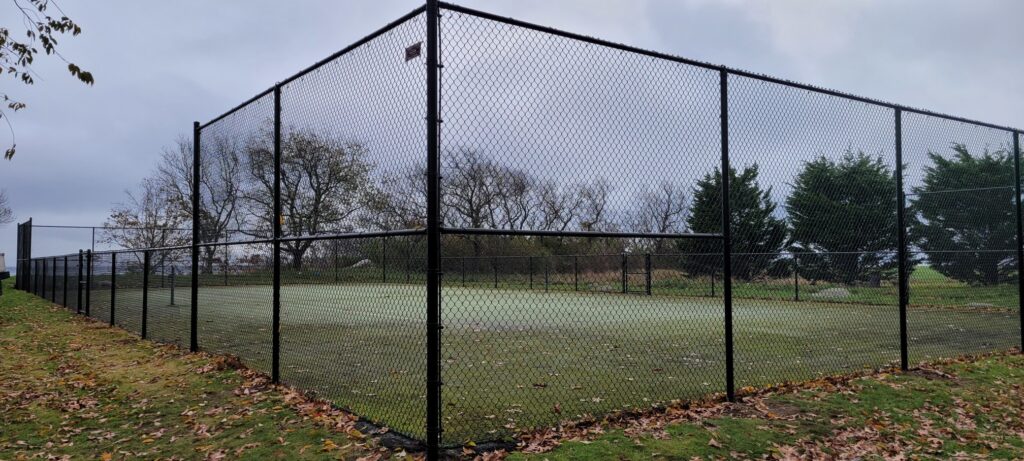
That is why a court enclosure is built differently from an ordinary yard fence. Heavier posts, a top rail and a mid rail, a taller fabric, and corner and gate posts braced to carry the load of a fence that is 10 or 12 feet high. The same structural thinking applies to a ball field backstop or a basketball court, though those have their own geometry.

How tall: 10 feet or 12 feet
Court fence comes in two standard heights. ASTM F969, a standard practice for chain-link tennis court fence that contractors still reference, addresses 10 and 12 foot enclosures (see the ASTM F969 listing; check which edition applies to your specification). In practice:
- 10 feet suits most private and neighborhood courts where play is recreational.
- 12 feet is common at clubs, schools and courts next to a road, parking lot or neighboring house, where a stray ball is a real problem.
- Some owners use a 12 foot fence behind the baselines and 10 feet along the sides, which is a way of spending height where balls actually travel.
Many Connecticut towns cap yard fences at 6 feet. Middletown’s zoning FAQ, for example, allows up to 6 feet along side and rear boundaries (see our Middletown fence page for the details). A court fence at 10 or 12 feet usually needs its own zoning conversation. Do that before you buy anything.
Court sizes and what they mean for the enclosure
The size of the area you enclose sets the footage of fence, the number of posts and where gates go. These are the common playing dimensions. The playing surface is not the same as the enclosed area, because players need run-off room.
| Court | Playing surface | What to plan for |
|---|---|---|
| Tennis (singles and doubles) | 78 by 36 feet | Enclosure with run-off space behind and beside the lines; commonly a rectangle of roughly 60 by 120 feet |
| Pickleball | 20 by 44 feet | A playing area of at least 30 by 60 feet is commonly recommended; several courts can share one enclosure |
| Basketball (half court) | Varies | Ball containment at the baseline and a gate placement that keeps the hoop pole clear |
The exact enclosure depends on the surface contractor’s layout. We build to the dimensions of the slab and the space around it, not to a catalog size.
Want a firm number for your property?
The parts of the system
Posts and framework
Corner posts, end posts and gate posts take the pull of the stretched fabric and are heavier than line posts. Top rail ties the line posts together and a mid rail stiffens the tall panel. Bracing at corners and gates is what keeps the fence square after the first winter.
Fabric
Chain link fabric comes in different gauges and mesh sizes, and it can be galvanized or vinyl-coated. Black vinyl-coated is the usual choice for courts because it fades into the background and does not reflect light into players’ eyes. Heavier fabric lasts longer and takes impact better, and it costs more. Ask for the gauge and mesh in writing so quotes can be compared.
Gates
A court needs a pedestrian gate, and usually a wider gate for a mower, a roller or a sweeper. Put gates where people actually enter and where equipment can reach, and hang them on posts sized for the weight. Our fence gate guide covers latches and hardware.
Windscreens and add-ons
Windscreens and privacy screens change how much wind the fence has to resist, so they need to be part of the design from the start, not added to a fence that was not built for them. If you want them, say so when you request the quote.
Connecticut conditions that decide how long a court fence lasts
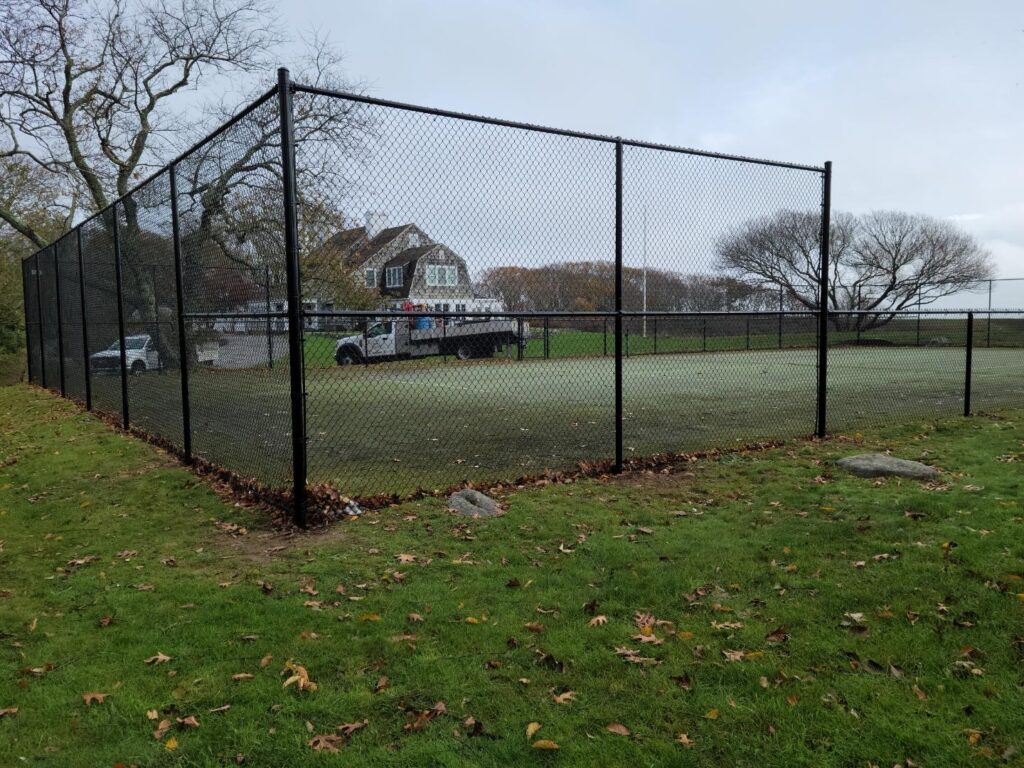
Frost. A 10 or 12 foot fence has a lot of surface for the wind to push on, and a lot of leverage on its posts. In Connecticut, frozen wet ground can lift and tilt a shallow post. Our guide to fence post depth and frost heave in Connecticut explains why depth and concrete work matter most.
Snow and plows. If the court is near a driveway or parking lot, a plow blade or a pile of heavy snow can bend the lower part of a fence. Plan where plowed snow will go.
Drainage and the slab. Posts are normally set outside the court slab or in its edge, in coordination with whoever builds or resurfaces the court. Settle who does what before work begins so no one cuts into new surfacing.
Salt air. Courts near the shore see salt spray, which is hard on bare steel. Vinyl-coated fabric adds a layer of protection over galvanizing.
Utilities. Call 811 before anyone digs. Court sites often have lighting conduit or drainage that nobody remembers. The Call 811 site explains the process.
When chain link is not the right choice for a court
Chain link is the standard, and for good reason, but it is not always right. A private residential court close to a neighbor’s windows may need something solid to reduce sight lines or noise, and that changes the permit conversation as well as the material. If appearance matters and the fence is far shorter than a court fence, a powder-coated aluminum fence is an alternative for the front, or a cedar privacy fence along one side. We will tell you if chain link is the wrong answer for your site.
Who we build court fences for
Arrow Fence builds commercial and recreational fencing for municipalities and parks departments, schools, HOA communities, churches and nonprofits, and private owners, using our own crews rather than subcontractors. You can look through our fence gallery to see the range of work we do. We visit the site, write a scope with materials and heights, and quote after measuring. If you plan to finance a private court fence, see our financing page.
Tennis court fence in Connecticut: common questions
How tall should a tennis court fence be?
Ten and twelve feet are the standard heights. ASTM F969, the practice chain-link contractors have long used for tennis court enclosures, was written for 10 and 12 foot fence. Ten feet is common on private and recreational courts. Twelve feet is more common where balls travel hard and far, such as clubs, schools and tournament-style courts, or where the court sits next to a road, parking or a neighbor.
Do I need a permit for a tennis court fence in Connecticut?
Usually you need to ask. A 10 to 12 foot enclosure is taller than the 6 foot limit many Connecticut towns set for yard fences, and the court itself may need zoning approval. Middletown, for example, limits fences along the sides and rear of a lot to 6 feet according to its zoning FAQ. Call the building and zoning office in your town before you design anything. Our fence permit guide lists what to bring.
Is black vinyl-coated chain link better than galvanized for a court?
Black vinyl-coated fabric is the usual choice for courts because it is less visually distracting and blends with trees and the surface. Galvanized fabric is bright silver, and some owners choose it for budget or for utility areas. Both are chain link, and installation quality matters more than color. We cover the trade-offs in our chain link vs ornamental iron guide.
Can a tennis court fence be used for pickleball?
Often yes. A pickleball court is 20 by 44 feet and is usually given a playing area of at least 30 by 60 feet, which fits inside a tennis court enclosure. You may want to check gate locations and where the fence sits relative to the new lines. Courts shared by both sports also raise questions about noise, so talk to neighbors and your town before you convert.
Does Arrow Fence install tennis court enclosures?
Yes. Tennis court enclosures, ball field fencing and park perimeter fencing are part of our commercial fencing work for parks, schools, municipalities, HOAs and private owners. Call (860) 267-6636 and we will schedule a site visit and quote after measuring.
How much does a tennis court fence cost?
It depends on footage, height, number of gates, terrain and whether windscreens or other add-ons are part of the plan. We do not give prices before measuring. A single court’s perimeter is a few hundred feet of 10 or 12 foot fence, and that length is what drives most of the number. Our Connecticut fence cost guide explains the factors.
Planning a court fence in Connecticut?
Tell us about the court, the height you are considering and who owns the site. We will visit, measure and give you a written quote built to your layout.
CT Home Improvement Contractor Reg. HIC.0537503