
Can You Build a Fence Near Wetlands in Connecticut?
If your yard touches a brook, a swampy corner or conservation land, a fence may trigger a local wetlands review. Here is how Connecticut’s inland wetlands law works in general terms, what usually matters and who to call before any post goes in.
Connecticut is a state of brooks, ponds, vernal pools and soggy corners, and a surprising number of back yards touch one of them. Homeowners often assume a fence is too small a project to matter to a wetlands commission. Sometimes that is true. Sometimes it is not, and finding out after the posts are set is expensive. This guide explains the framework in plain English: what counts as a wetland or watercourse, why a fence outside the wetland can still get reviewed, how to find out for your property and what design choices make a fence easier to approve. It is general information, not legal advice, and the rules are set town by town, so confirm with your town before you build. Arrow Fence is not a wetlands consultant and does not decide whether a permit is required.
Maybe. Connecticut requires every town to regulate activities in and near inland wetlands and watercourses, and each town’s wetlands agency sets its own details, including how far beyond the wetland its review reaches. Many fences are fine, but one near a brook, swamp, pond or marsh may need a permit or a written no-permit determination first. Call your town’s wetlands agent before you hire, dig or order, and have them confirm in writing.
In this guide
- Can you build a fence near a wetland in Connecticut?
- What counts as a wetland or watercourse
- Why a fence outside the wetland can be reviewed
- Is a fence an exempt use?
- How to find out what applies to you
- Other rules near water
- Designing a lower-impact fence
- What if you build without checking?
- When a fence is the wrong choice
- Fences near wetlands: common questions
Can you build a fence near a wetland in Connecticut?
Often you can, but not always without asking first. The legal structure is simple to describe. In 1972 Connecticut passed the Inland Wetlands and Watercourses Act, found in Chapter 440 of the General Statutes. The act makes it state policy that inland wetlands and watercourses be regulated by municipalities, and, as the DEEP Inland Wetlands and Watercourses page explains, every town has established an inland wetlands agency to do it. The agency may be called a commission, a board or a conservation and wetlands commission, and many towns have a staff agent who handles routine questions.
That agency writes local regulations that decide how the law works in your town. Two things about those regulations matter for a fence. First, they define the area regulated, which often reaches beyond the wetland itself. Second, they say which small projects can be approved quickly by staff and which need a full application, notice to neighbors and a public hearing.
Because the details are local, the safest path is a short call or email to your town’s wetlands agent early in your planning. For the broader permitting picture, read our fence permit guide.
What counts as a wetland or a watercourse?
You cannot always tell by looking. The statute defines the terms in Section 22a-38, and the definitions are broader than most people expect.
- Wetlands are defined by soil, not just by standing water. They are land that consists of soil types classed as poorly drained, very poorly drained, alluvial or floodplain by the National Cooperative Soil Survey. A lawn that is dry in August can still be wetland soil.
- Watercourses include rivers, streams, brooks, waterways, lakes, ponds, marshes, swamps and bogs, natural or artificial, including vernal and intermittent ones that meet the statute’s tests, such as a defined channel and bank.
- Regulated activity is any operation within or use of a wetland or watercourse involving removal or deposition of material, or any obstruction, construction, alteration or pollution of it. Digging post holes, grading, filling and clearing can all fit that description. So can a fence that obstructs the flow of a watercourse.
Soil scientists can identify wetland soil and flag its edge in the field. The free USDA Web Soil Survey shows mapped soil drainage classes for any address, which is a helpful first look but not an official determination. Vernal pools, which are seasonal and easy to miss in summer, have their own DEEP information page.
Why can a fence outside the wetland still be reviewed?
Many local wetlands regulations extend review to an upland review area, a strip of ordinary land around the wetland or watercourse where digging, clearing or grading could affect it. The distance is set by the town and varies; some towns use a modest buffer and others use a wide one, and some set larger buffers for particular features such as streams or vernal pools. Your town’s regulations and map will say what applies to your lot.
The reasoning is practical. Digging, equipment traffic, bare soil and clearing near a wetland can wash sediment into it, compact its edges or change how water moves. A fence is a small project, but the work around it is the same kind of disturbance a commission is charged with watching. That is why the question is not “is my fence in the wetland?” but “is my work in, or close enough to, the regulated area?”
A wetlands approval is separate from zoning and building review. A fence can meet your town’s zoning height and setback rules and still need wetlands sign-off. Check both. Our permit guide and property line guide cover the other pieces.
Does a fence in your own yard count as an exempt use?
The statute lists activities that are permitted as of right in wetlands and watercourses. One category in Section 22a-40 is uses incidental to the enjoyment and maintenance of residential property, which the law says includes maintenance of existing structures and landscaping but does not include removing or depositing significant amounts of material from or onto a wetland or watercourse or diverting or altering a watercourse. Farming, nurseries and gardening have their own category.
What that means for your fence is a question for your town. Maintaining or repairing an existing fence is closer to the wording than building a new one. Whether a particular new fence is treated as incidental, as a minor activity that staff can approve, or as a regulated activity that needs an application depends on how your town reads its regulations and on the specifics: how close to the wetland, how much digging, whether any grading or clearing is involved and whether the fence crosses a watercourse. Some towns issue a short written determination that no permit is required. Ask for that in writing and keep it with your records.
How do you find out what applies to your property?
You do not need a lawyer to start. These steps work in most towns.
- Look at your survey and any approved plans. Wetland lines, conservation easements and building envelopes are often shown. A closing survey may be out of date.
- Check the town’s maps. Many towns publish inland wetlands maps or GIS layers. Treat them as a screening tool, not a final answer.
- Call or email the wetlands agent. The land use, planning or conservation office can tell you who that is. Describe the fence, where it goes, how many posts and whether you will dig by hand or use equipment.
- Ask what you need in writing. That might be a permit, an agent approval, a no-permit determination or confirmation that none is needed.
- Ask if a soil scientist is needed. If the edge of the wetland is unclear and your plan is close, the agency may require a professional flag.
- Check for other restrictions. Conservation easements, deed restrictions, land trust agreements and HOA covenants can limit fences even where no wetlands rule applies. See our HOA fencing guide.
If your town’s staff are slow to respond, ask when the commission meets next, because some approvals are handled at monthly meetings.
Want a firm number for your property?
What other rules can apply near water?
- Floodplains and flood zones. A fence in a mapped flood zone may face additional building or zoning rules, and solid fences can trap debris in a flood. DEEP’s flood management page is a starting point.
- Tidal wetlands. The inland law does not cover tidal wetlands, which are regulated separately by the state. If you are on the shoreline, read DEEP’s tidal wetlands page and our coastal fence materials guide.
- Public water supply land. Properties in a water company watershed may have extra notice requirements.
- Conservation land next door. A neighbor that is a town park, land trust or conservation area may have its own boundary rules, and you should not set posts on its land. See the property line guide.
- Federal rules. Larger projects can fall under federal wetland rules. A fence rarely does, but it is another reason to ask your town first.
How do you design a fence that is easier to approve near wet ground?
If a wetlands agency does review your fence, a lower-impact plan helps. Nothing here guarantees approval, and every agency decides for itself, but these are the kinds of choices commissions tend to appreciate.
- Keep it out of the wet part. Run the fence along the upland side of the wetland edge instead of through the swale or across the stream bank.
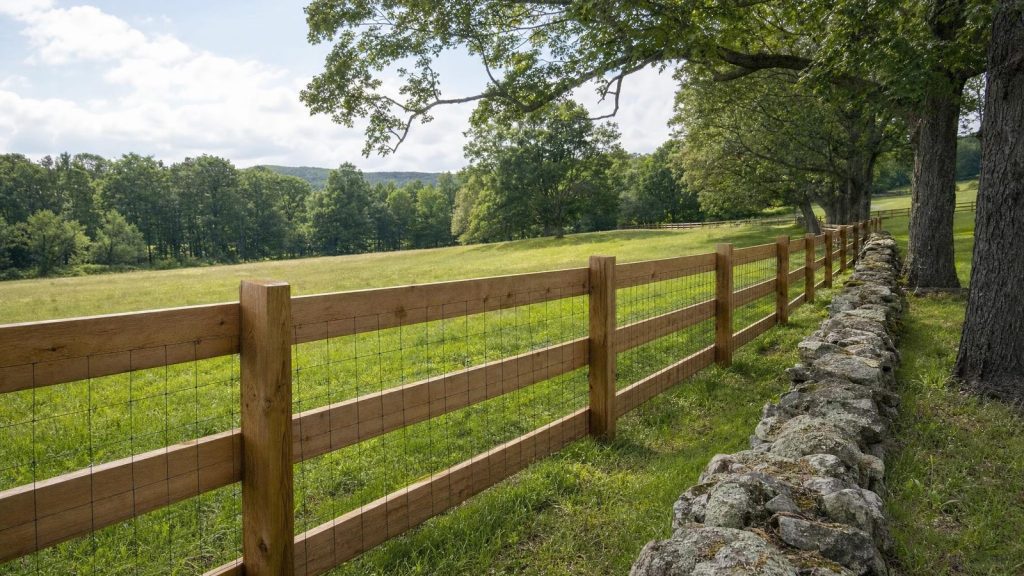
- Choose an open design. Post-and-rail, wire mesh or open aluminum let water, leaves and small wildlife pass. A solid privacy fence can dam runoff and block animal movement. See our rail fencing page for a typical open style.
- Minimize digging. Hand-digging or fewer posts near the wetland edge reduces disturbance. Machines in wet soil leave ruts that last for years.
- Control soil. Stockpile spoil away from the wetland and put sediment controls where the agency asks.
- Do not clear or grade. Avoid cutting vegetation along the bank or filling low spots to make a level fence line.
- Leave a path for water and wildlife. A gap at the bottom or a break at a swale can keep the fence from acting as a dam.
- Time the work. Dry weather is better for wet sites. Our best time to install guide explains how the ground changes through the year.
On a slope near water, erosion is an added concern. Our sloped yard guide covers drainage and soil, and the idea of keeping the fence off the steepest bank applies even more near a stream.
What happens if you build without checking?
Statute Section 22a-44 lets an inland wetlands agency or its agent issue a written cease-and-desist order to anyone conducting an activity in violation of the act or the local regulations, and it provides for penalties and court orders. Agencies can also require restoration of disturbed areas. In practice, the common outcome is a stop-work order, a delay and a bill for fixing something that could have been avoided with a phone call.
Two other consequences are less obvious. A violation can come up when you sell, since a buyer’s attorney may ask about permits for work done on the property. And a contractor who builds in the wrong place can be caught between your instructions and your town’s rules. That is why we ask you to confirm local approvals before we set posts, and why we build along the line that you or your surveyor mark.
When is fencing next to wetlands the wrong choice?
Sometimes the best answer is a smaller fence or no fence in that spot.
- The wetland edge is unknown. If you cannot tell where the regulated area begins, resolve it first.
- The fence has to cross a stream or swale. This is an obstruction question, and commissions look at it closely.
- The goal can be met another way. A fence around the play area or garden, not the entire lot, may stay out of the regulated area entirely. Our garden and deer fence guide and dog fence guide show how targeted fences work.
- You are on conservation land or a land trust easement. The documents on that land come first.
If you live in a town with lots of ponds, lakes and wet woods, such as Salem, Granby or Avon, ask early. Our pages for Salem, Granby and Avon and Canton show where we work.
Fences near wetlands: common questions
Do I need a wetlands permit to build a fence in Connecticut?
It depends on your town and your site. Every town has an inland wetlands agency, and many regulate work in and near wetlands and watercourses. A fence far from wet ground usually does not need review. One near a brook, swamp or pond may. Ask your town’s wetlands agent and get the answer in writing.
How close to a wetland can I build a fence in Connecticut?
There is no single state distance. Each town’s regulations set the area it reviews, often called the upland review area, and distances vary by town and by feature. Your wetlands agent can tell you the rule for your lot and whether a soil scientist needs to flag the edge before you plan the fence line.
What is a regulated activity under the Inland Wetlands and Watercourses Act?
Section 22a-38 defines it as any operation within or use of a wetland or watercourse involving removal or deposition of material, or any obstruction, construction, alteration or pollution of it, with some exceptions in Section 22a-40. Digging, filling, grading and obstructing flow can all qualify, depending on location and local rules.
Is a fence near a brook treated differently from a fence near a swamp?
Both are watercourses or wetlands under the statute, and both can be regulated. A brook adds questions about flow, flood debris and obstruction, so a fence across or at the edge of the channel is looked at closely. Open designs set back from the bank are generally easier to justify, but your agency decides.
Does my contractor handle the wetlands approval?
Do not assume so. Arrow Fence builds the fence you have approved and along the line you or your surveyor mark, but we are not wetlands consultants and we do not decide whether a permit is required. Talk to your town’s wetlands agent first and give your contractor any written determination or permit before work starts.
What if my neighbor’s land is conservation land?
Conservation land can be town, land trust or state property with its own rules and boundaries. Do not place posts on it or clear along its edge without permission. Get a survey if the line is unclear, ask the owner or land trust about restrictions and check whether a conservation easement affects your lot.
Where can I find the Connecticut inland wetlands law?
The law is in Chapter 440 of the Connecticut General Statutes, Sections 22a-36 through 22a-45. DEEP publishes an Inland Wetlands and Watercourses page with general information for the public and for municipal agencies. Your town’s own regulations, available from the land use or planning office, are what actually apply to your fence.
Planning a fence near wet ground?
Tell us what is on your property, where the fence would go and what your town has told you. We will walk the line, talk through open and low-impact designs and write the scope clearly. Fabricated in our East Hampton shop and installed by our own crews.
CT Home Improvement Contractor Reg. HIC.0537503