
Wood vs Vinyl Fence: 20-Year Cost in Connecticut
The sticker price is only the first number. Here is how wood and vinyl fences compare over twenty Connecticut winters, which costs repeat, which ones surprise people and where each material saves or loses money.
Most fence comparisons stop at the installed price per foot. That is useful, but it is not what you end up paying. A cedar fence asks for stain and a few new boards over the years. A vinyl fence asks for water and a soft brush, then costs more on day one. Over twenty years those differences can narrow, vanish or even reverse, depending on how you handle upkeep and how rough your yard is on a fence. This guide walks through the cost drivers, uses only price ranges that appear in our published Connecticut cost guides, and does some simple arithmetic so you can see how the pieces fit. Nothing here is a quote. Your price depends on your lot.
Over twenty years in Connecticut, vinyl usually costs more up front and almost nothing to maintain, while cedar costs less up front and then needs staining and occasional board replacement. If you do the staining yourself, the 20-year totals can land close together. If you pay someone to stain, or you skip upkeep and the wood fails early, vinyl tends to come out ahead. Pressure-treated wood is the cheapest option throughout.
In this guide
- Is wood or vinyl cheaper over 20 years in Connecticut?
- What each fence costs to install
- What upkeep costs
- How the 20-year totals add up
- The costs that surprise people
- When wood wins and when vinyl wins
- When neither is the right choice
- How to compare quotes fairly
- Wood vs vinyl fence cost: common questions
Is wood or vinyl cheaper over 20 years in Connecticut?
The honest answer is: it depends on who does the upkeep and how long you want the fence to last. Vinyl costs more to install and very little to keep. Cedar costs less to install and more to keep. The ownership gap between the two is smaller than the sticker gap suggests, and it can flip in vinyl’s favor if you pay a contractor to stain or if the wood is neglected.
Three questions decide the outcome for your yard.
- Will you stain the wood yourself, hire it out, or not at all? A fence that never gets finished ages faster. Our cedar staining guide shows what a good finish takes.
- How much does your yard punish a fence? Damp shade, sprinklers, snow piles, plows and trees all raise wood and vinyl costs, in different ways.
- How long will you own the property? If you plan to sell in five years, the 20-year math matters less than how the fence looks at sale.
The rest of this guide goes through what you pay at install, what you pay each year, what can go wrong and what it costs to take the fence out at the end.
What does each fence cost to install?
These are the Hartford County installed ranges published in our 2026 fence installation cost guide, with the pressure-treated range from our wood privacy fence cost guide. They are planning figures, not quotes.
| Material | Installed range per linear foot | Illustrative 150-foot back yard (simple arithmetic) |
|---|---|---|
| Pressure-treated pine privacy | About $18 to $30 | About $2,700 to $4,500 |
| Cedar privacy | About $25 to $45 | About $3,750 to $6,750 |
| Vinyl privacy | About $30 to $55 | About $4,500 to $8,250 |
The 150-foot figure is just the per-foot range multiplied out, using the same 150-foot example our cost guide uses for cedar. Gates, permit fees, old fence removal and difficult terrain are extra and can move a total a lot. Our sloped yard guide and best time to install guide cover two things that change the number.
At install, vinyl is typically the most expensive of the three and pressure-treated wood the cheapest. The vinyl premium over cedar in these ranges is roughly $750 to $1,500 for a 150-foot fence. Whether that premium buys you anything depends on the next sections.
What does upkeep cost each year?
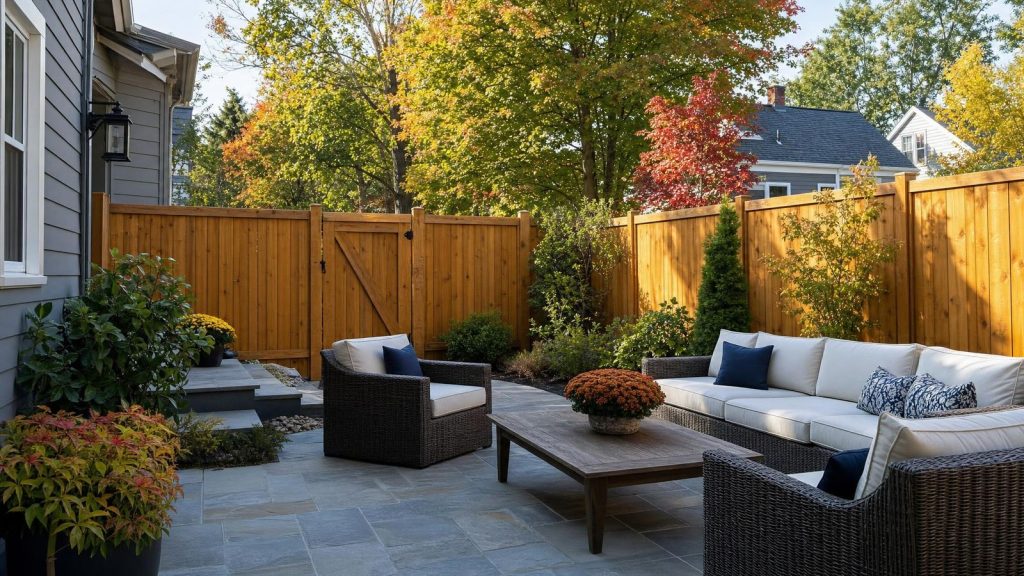
Cedar and pressure-treated wood
Our guides give two ways to think about staining. The cost guide says to plan on staining or sealing every two to three years. The wood fence cost guide describes re-staining or re-sealing every three to five years and puts DIY materials at roughly $1 to $2 per linear foot per application, plus cleaning every year or two and replacing a few boards every five to seven years. Our winter maintenance guide explains why Connecticut freeze-thaw cycles are tough on exposed wood.
For the 150-foot example, one DIY application is about $150 to $300 in materials. Over twenty years at every three to five years, that is roughly four to six applications, or about $600 to $1,800 in materials alone, before your time, tools, ladders or any professional labor. Hiring the work out adds labor, and we are not going to invent a number for that; ask two or three finishing contractors for a quote on your fence.
Vinyl
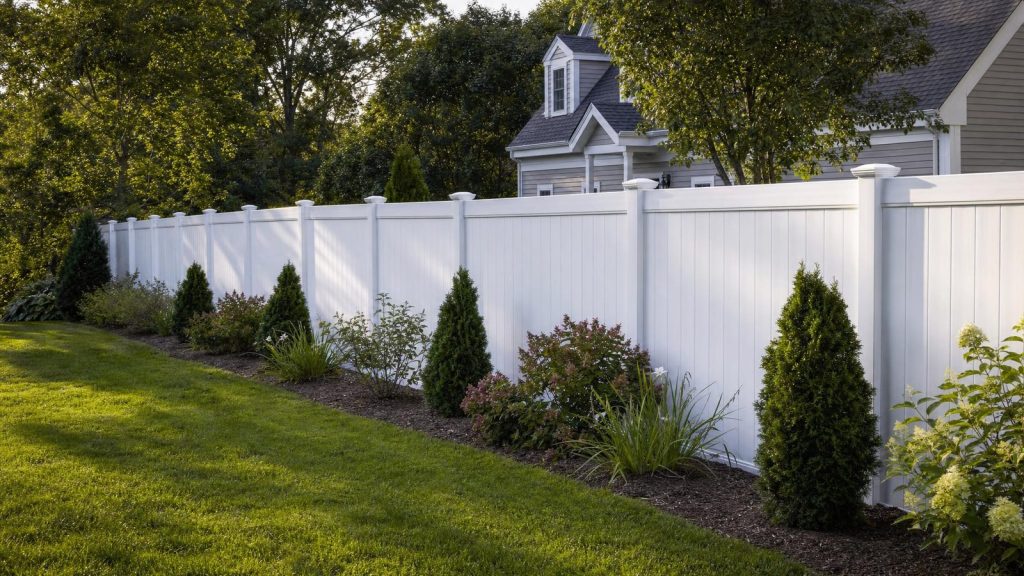
Vinyl has no staining, painting or sealing. The ownership routine is a spring rinse with a garden hose, soap and a soft brush on green mildew in shady spots, a gate hinge check once a year and clearing fallen branches. That is a few dollars in supplies and a couple of hours a year. Our vinyl fence guide covers the routine.
So on pure upkeep, vinyl saves you something every year and wood costs you something every few years. The size of the gap depends mostly on whether you pay yourself or someone else.
How do the 20-year totals add up?
Here is a simple model for a 150-foot privacy fence using only the ranges above. It is intentionally incomplete, so treat it as a framework, not a prediction.
| Cost piece | Cedar (DIY upkeep) | Vinyl |
|---|---|---|
| Install, low to high | $3,750 to $6,750 | $4,500 to $8,250 |
| Staining materials, 4 to 6 coats at $150 to $300 | $600 to $1,800 | None |
| Cleaning and supplies | Small | Small |
| Replacement boards or panels | Cost varies by damage | Cost varies by damage and product availability |
| Rough subtotal before labor, gates and repairs | About $4,350 to $8,550 | About $4,500 to $8,250 |
On these assumptions, the two materials land within a few hundred dollars of each other in the middle of the range. That is the honest finding: when you do the staining, wood and vinyl come out much closer over twenty years than the install prices suggest. Add paid staining labor, and vinyl pulls ahead. Skip upkeep entirely, and cedar saves money in the short term but may need earlier replacement, which erases the advantage. Our wood guide lists a typical lifespan of 20 to 30 years for cedar with proper maintenance and 15 to 25 years for pressure-treated pine, so a twenty-year horizon sits near the end of the useful life for wood fences that were looked after.
We do not publish a lifespan figure for vinyl. Damage usually comes from impact, wind or settling posts rather than age, and manufacturers publish their own warranty terms. Ask for the written terms for the exact product being quoted.
Want a firm number for your property?
What costs surprise people?
- Gates and hardware. Each gate is its own mini project. Our cost guide lists about $400 to $1,200 per gate depending on material and size. Gates are also where wood sags and vinyl needs strong posts. See our gate guide.
- Posts and frost. A post that heaves or leans costs the same to fix in either material. Our post depth guide explains why posts matter more than the surface material.
- Removal. Our cost guide lists about $3 to $8 per linear foot for old fence removal and disposal. That is a cost at the start if you are replacing something and a cost at the end for whatever you build today. See replacing an old fence.
- Mildew and cleaning. White vinyl shows green mildew in damp shade. It is not damage, but it takes a few minutes of work.
- Impact and weather damage. Plow blades, trees and mowers damage both materials. Wood boards are easier to patch a piece at a time. Vinyl panels are replaced in sections, and matching availability is worth asking about.
- Color fade and finish wear. Wood finish fades and needs attention. Vinyl holds color well but sun can dull it over many years.
- Permit fees and surveys. Same for both. See our permit guide.
When does wood win, and when does vinyl win?
Wood tends to win when
- The perimeter is large. Pressure-treated pine in particular keeps the up-front cost down on long runs. Our wood guide says the savings over cedar at 400 linear feet or more can be thousands of dollars.
- You enjoy the work, or you like the natural look and are fine staining every few years.
- The setting is rustic, historic or wooded, where wood simply looks right.
- The ground is steep or irregular. Wood can be cut and contoured to follow it.
- You might change the fence in a few years and do not want to pay a premium now.
Vinyl tends to win when
- You will not stain a fence, and you do not want to pay someone to.
- The yard is small, flat and privacy is the goal, such as a patio or a pool surround.
- Damp, shady or sprinkler-wet conditions beat up wood quickly.
- You want a bright, uniform finish in white or tan. We install vinyl in those two colors only.
- You plan to stay put long enough to enjoy the savings in time and effort.
When is neither the right choice?
Sometimes the cheapest 20-year fence is neither of these. If you do not need privacy, aluminum is another low-maintenance option, and our aluminum vs vinyl comparison shows how it stacks up. If you need a basic boundary for a large yard or an athletic field, chain link is often the lowest-cost lifetime option. If you need a very low initial cost and are comfortable with a shorter life, pressure-treated pine is the budget choice. And if your existing fence just needs a few repairs, our repair vs replacement guide will keep you from spending on a new fence you do not need.
If you are in the Middletown area, our Middletown fence page shows our local work, and our vinyl and cedar privacy pages show finished fences of each kind.
How do you compare two quotes fairly?
To compare wood and vinyl over twenty years, the quotes have to describe the same thing. Ask each contractor to write down:
- The material, grade, height and style, including post size and material.
- Post depth and how posts are set, especially gate posts and corners.
- The number and type of gates and hardware.
- Whether old fence removal and disposal is included.
- Who pulls any permit and what the permit costs.
- What is included for finish on wood, and what the manufacturer warranty says for vinyl.
Verify that any contractor is registered with the state through eLicense; ours is HIC.0537503. For general homeowner guidance on wood moisture and decay, UConn Extension is a good starting place. Our guide on what to ask your fence contractor has more questions.
Wood vs vinyl fence cost: common questions
Is a vinyl fence cheaper than wood in the long run?
Not automatically. Vinyl costs more to install and almost nothing to maintain. Cedar costs less to install but needs staining every few years. If you stain it yourself, the 20-year totals can land close together; if you hire out the staining or skip it, vinyl often comes out ahead. Pressure-treated pine is the cheapest option overall.
How much does it cost to maintain a wood fence in Connecticut?
Our guides cite staining or sealing every two to five years, with DIY materials around $1 to $2 per linear foot per coat, plus cleaning and occasional board replacement. A 150-foot fence is roughly $150 to $300 in materials per coat. Professional staining adds labor, so get a quote for your fence.
How long does a wood fence last compared with vinyl?
Our wood cost guide lists 20 to 30 years for cedar and 15 to 25 years for pressure-treated pine with proper maintenance. Vinyl does not rot or rust, so damage usually comes from impact, wind or settling posts. Manufacturer warranties differ, so ask for written terms for the product you are quoted.
Does vinyl fence need any maintenance?
A little. A spring rinse with a hose, soap and a soft brush on green mildew in shady areas, a yearly check of hinges and latches, and removing fallen branches. There is no staining, painting or sealing. Vinyl can crack from a hard hit in deep cold, so keep plowed snow off it.
Which is cheaper to install, wood or vinyl?
In our Hartford County cost guide, cedar privacy runs about $25 to $45 per linear foot and vinyl privacy about $30 to $55 installed, with pressure-treated pine lower still. Gates, terrain, height and removal change the total, so a measured written estimate is the only reliable comparison.
What costs extra with either kind of fence?
Gates and hardware, old fence removal and disposal, permit fees, surveys, tough terrain and ledge, and extra height. Our cost guide lists about $400 to $1,200 per gate and $3 to $8 per linear foot for removal. Ask each contractor to list these items so quotes compare fairly.
Which is better for resale, wood or vinyl?
There is no reliable rule, and we do not want to guess. Buyers respond to a fence that looks tidy and fits the house. A well-kept cedar fence and a clean vinyl fence both help, while a faded, leaning or mildewed one of either kind can hurt. Condition and fit matter more than the material.
Get numbers for your yard, not an average
The only way to compare wood and vinyl for your property is a measured, written estimate. We will price both options side by side. Fabricated in our East Hampton shop and installed by our own crews.
CT Home Improvement Contractor Reg. HIC.0537503